

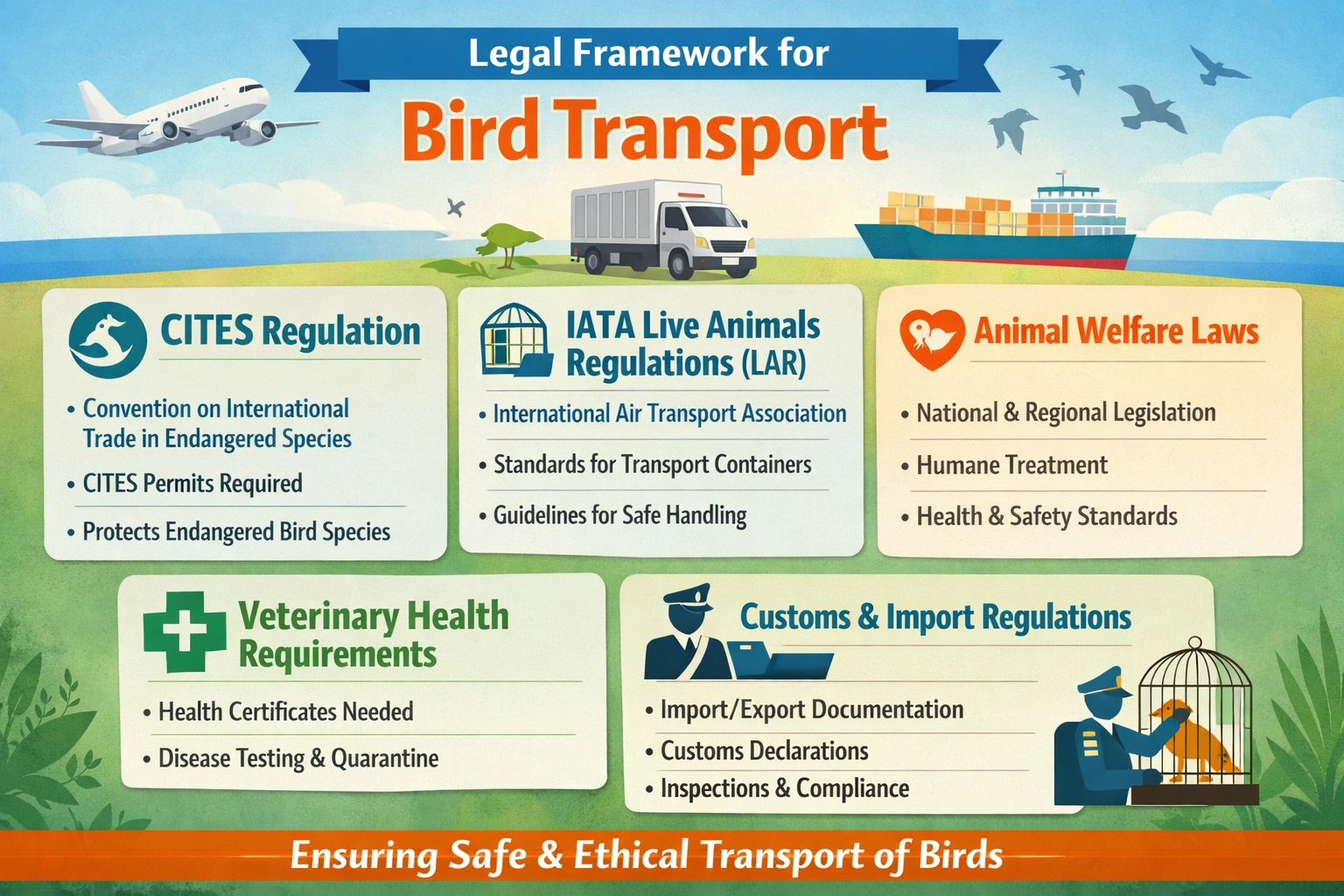
Transporting parrots, whether across town or across continents, operates within a complex legal framework designed to protect animal welfare and prevent disease spread. The Virginia Administrative Code provides detailed standards for bird transportation that exemplify requirements found across jurisdictions . These regulations establish minimum standards for primary enclosures, conveyances, handling procedures, and care during transit that protect birds from injury, stress, and environmental extremes.
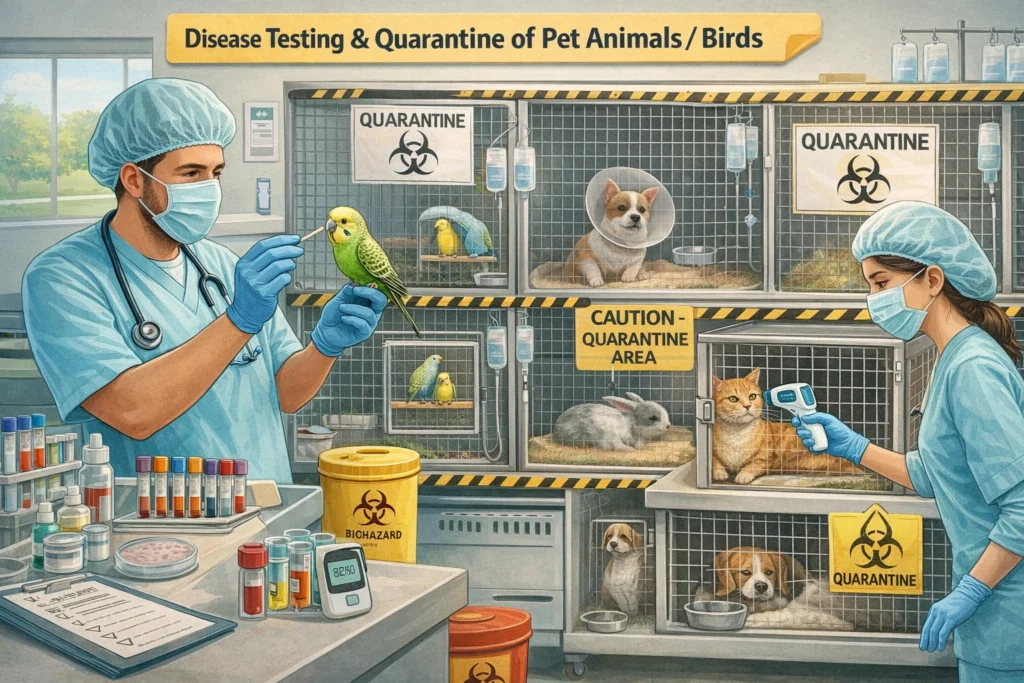
Federal requirements add additional layers of regulation, particularly for interstate and international transport. The U.S. Fish and Wildlife Service regulates wildlife shipments under CITES and the Wild Bird Conservation Act, requiring permits and inspections for many movements . The Department of Agriculture’s Animal and Plant Health Inspection Service oversees animal health certifications and may impose quarantine requirements . Understanding applicable requirements before transport prevents legal complications and ensures birds move safely and legally.
Primary Enclosure Requirements
The primary enclosure—the carrier or crate containing the bird during transport—must meet specific structural and design standards to ensure safety. Regulations require that enclosures possess sufficient structural strength to contain the birds and withstand normal transport rigors . This means carriers must resist crushing from stacked cargo, survive handling bumps, and prevent escape even if dropped or tipped.
Interior surfaces must be free from protrusions that could injure birds . Sharp edges, exposed fasteners, or rough surfaces can cause injury as birds move within the enclosure during transport. Openings must provide proper ventilation while preventing escape, with aperture sizes appropriate to the bird species being transported .
For enclosures with ventilation openings, projecting rims or devices on exterior walls prevent obstruction of those openings during transport, maintaining at least 0.75 inches of air circulation space between the enclosure and any adjacent cargo or conveyance wall . This seemingly minor detail proves critical for maintaining adequate airflow when enclosures are stacked or placed against other cargo.
Space and Comfort Provisions
Adequate space within the primary enclosure ensures bird comfort and safety during transport. Enclosures must be large enough that each bird can turn about freely using normal body movements and perch comfortably . For parrots accustomed to perching, the ability to maintain normal posture reduces stress during transport.
However, regulations recognize exceptions for certain species where restricted movement may be appropriate according to professionally accepted standards, such as when freedom of movement would constitute a danger to the animals, handlers, or other persons . This provision acknowledges that some birds may need temporary restraint for safety during specific transport situations.
Solid bottoms prevent leakage of excreta or fluids during transport, protecting both the birds and surrounding cargo . Absorbent materials or wire mesh flooring above the solid floor manage waste while keeping birds clean and dry. Clean, nontoxic litter materials may be used, provided they pose no threat to bird safety.
Labeling and Identification
Proper labeling ensures handlers recognize and appropriately manage bird shipments. Primary enclosures must be clearly marked on top and on one or more sides with the words “Live Animal” or “Wild Animal,” as appropriate, in letters not less than 1 inch in height . Arrows or other markings indicate the correct upright position, preventing handlers from tipping or inverting enclosures.
These requirements apply to individual enclosures but may not apply to primary conveyances used as enclosures or to permanently affixed enclosures within the conveyance . However, clear communication of contents and handling requirements remains essential regardless of specific regulatory applicability.
Primary Conveyance Standards
The vehicle or aircraft transporting birds—the primary conveyance—must meet standards protecting bird health and safety during transit. Cargo spaces must be constructed to prevent ingress of engine exhaust fumes and gases that could poison birds during transport . Adequate air supply for normal breathing must reach each bird, with enclosures positioned to ensure access to sufficient air .
Temperature control represents a critical safety factor during transport. Regulations specify that temperatures in primary conveyances must not exceed 75°F for more than 45 minutes without supplemental ventilation, nor fall below 45°F without auxiliary heat .
Exceptions exist for birds accompanied by certificates of acclimation to lower temperatures signed by an accredited veterinarian, or when bird welfare mandates temperature maintenance outside these ranges .
For vehicle transport, enclosures must be positioned for emergency removal of birds if needed . The interior of animal cargo spaces must be kept clean, and birds must not be transported with any material, substance, or device that could injure their health or well-being .
Vehicles used to transport birds must be enclosed—vans, station wagons, or pick-up trucks equipped with camper shells—with all sides and top covered. Adequate ventilation must be assured through screens or ventilation systems, and vehicles must be insulated or equipped with automatic heating and cooling systems to protect from weather extremes .
Terminal Facility Requirements
When transport involves stops at terminals or holding facilities, additional standards apply. Animal holding areas must not commingle bird shipments with inanimate cargo . Facilities must be cleaned and sanitized frequently to prevent debris or excreta accumulation, minimize vermin infestation, and prevent disease hazards. Effective programs for insect, ectoparasite, and avian pest control must be maintained .
Fresh air must be provided through windows, doors, vents, or air conditioning, with fans, blowers, or air conditioning systems circulating air to minimize drafts, odors, and moisture condensation . Temperatures must be maintained between 45°F and 85°F, with auxiliary ventilation provided when temperatures exceed 75°F .
Food and Water During Transport
For transport longer than two hours, adequate food and water or alternate moisture sources must be provided within primary enclosures . This requirement applies to anyone offering birds to carriers for transport and to those transporting birds in their own conveyances.
However, exceptions may apply for some birds according to professionally accepted standards, recognizing that some species may not require food or water during specific transport durations .
Carriers may not accept birds for transport unless these provisions have been met, placing responsibility on both shippers and carriers to ensure appropriate food and water arrangements .
Care During Transit
Throughout transport, designated personnel bear responsibility for bird welfare. Birds must be visually observed as frequently as circumstances dictate, but not less than once every four hours during surface and air transit . When animal cargo spaces are not accessible during flight, observations occur during loading, unloading, and whenever the space is otherwise accessible.
Observers must verify that birds receive sufficient air for normal breathing, that ambient temperatures remain within prescribed limits, that additional ventilation is provided when needed, and that no birds show obvious physical distress . Any needed veterinary care must be provided as soon as possible .
Birds must not be removed from their primary enclosures unless placed in other enclosures or facilities conforming to transport standards . This prevents ad hoc handling arrangements that could compromise bird safety.
Handling Procedures
Moving birds to or from conveyances and terminal facilities requires careful handling. Birds must be moved as expeditiously as possible . Sufficient shade must protect birds from direct sun, and they must not be subjected to temperatures exceeding 85°F for more than 45 minutes during handling .
When outdoor temperatures fall below 50°F, covered transporting devices must protect birds, with exposure below 45°F limited to 45 minutes unless acclimation certificates authorize lower temperatures .
Shelter from precipitation keeps birds dry during handling. Primary enclosures must not be handled in ways causing physical or emotional trauma, and handlers must not toss, drop, or needlessly tilt enclosures, nor stack them in ways risking falls .
Species Considerations
Transport requirements recognize that different species have different needs. Primary enclosures may contain only birds of the same species, with exceptions for species that may travel together according to professionally accepted standards . Birds within enclosures must be in compatible groups, preventing aggression or stress during transport.
These species-specific considerations extend to temperature requirements, space allowances, and handling procedures. What works for small parakeets may prove inadequate for large macaws, and regulations anticipate these differences through provisions for professionally accepted standards tailored to particular species .
Transporting a parrot from one country to another by air involves navigating a complex web of federal regulations, international treaties, and airline-specific policies. For a U.S. audience, the process is defined by the rules of the destination country, the requirements of the U.S. government, and the strict limitations of commercial airlines. Given that many commercial airlines refuse to transport large parrots, this is a detailed, multi-step process that requires months of planning.
Here is a comprehensive guide on how to transport a parrot internationally by air for a U.S.-based owner.
1. The Foundational Rule: The Destination Country Calls the Shots
The single most important thing to understand is that the U.S. Department of Agriculture (APHIS) does not dictate the requirements for exporting a bird; the destination country does . Every country has its own unique set of rules regarding which species can enter, what tests are required, and what quarantine periods are mandatory.
- Your First Step: You must identify the specific requirements of the country you are moving to.
- Where to Look: The APHIS website maintains the International Regulations (IRegs) system. You can select your destination country from a dropdown menu to view the available health certificates and specific requirements for birds .
- Unknown Requirements: If your country is not listed, it means APHIS has not been officially informed of the requirements. In this case, you must contact the animal health officials (the Ministry of Agriculture or equivalent) in the destination country directly to obtain the necessary information .
2. The U.S. Government Requirements:
The Paperwork Trail
Regardless of where you are going, the U.S. government mandates specific steps to ensure the bird is legally and healthily exported.
- CITES (The Convention on International Trade in Endangered Species): This is the most critical international law for parrots. Most parrots are listed on CITES Appendix II, meaning they are not necessarily endangered now but could become so without strict trade controls.
- The Requirement: You must apply for a CITES export permit from the U.S. Fish and Wildlife Service (USFWS).
- This is your bird’s “passport” proving it was legally acquired and bred .
- For Frequent Travelers: If you travel internationally with your bird frequently (e.g., for shows or you split time between countries), you can apply for a CITES Certificate of Ownership, which functions like a passport for multiple entries and exits .
- USDA Endorsed Health Certificate:
- The Examination: You must take your parrot to a USDA-accredited veterinarian. For pet birds, this veterinarian must be Category II accredited .
- The vet will perform an examination and complete the required health certificate for the destination country.
- The Timeline: The export certificate must usually be issued within a specific timeframe (often 10-14 days) before the bird departs the U.S. .
- Federal Endorsement: After the vet issues the certificate, you must send it (and all supporting lab results) to your local APHIS Veterinary Export Trade Services Endorsement Office. An APHIS official will review the documents to ensure they meet the destination country’s rules and will then “endorse” them with an official stamp or signature.
- This is a required step for most countries .
- USFWS Declaration:
- All wildlife being exported must be declared to the U.S. Fish and Wildlife Service using Form 3-177 (Declaration for Importation or Exportation of Fish or Wildlife) . This is now most easily done through the USFWS “edecs” (Electronic Declarations) online system .
- Designated Ports: Wildlife must generally be exported through a designated USFWS port. If you are not near one, you may need to apply for a Designated Port Exception Permit (DPEP) well in advance .
3. The Airline Challenge: The Biggest Hurdle
Once you have the government paperwork, you need to book the flight. This is often the most difficult part of moving a parrot.
- The “Small Household Bird” Distinction: Major U.S. airlines strictly differentiate between “small household birds” (like budgies/parakeets and canaries) and large parrots (like African Greys, Macaws, and Cockatoos).
- Cabin Travel: Most airlines, such as Frontier, only allow small pets to travel in the cabin if they can fit in a carrier under the seat and are considered “small household birds.” However, these airlines explicitly ban large parrots from the cabin . For example, Frontier’s policy states they accept “small household birds” on domestic U.S. flights, but on international flights, only dogs and cats are permitted .
- Cargo vs. Checked Baggage:
- Many U.S. airlines have stopped accepting live animals as checked baggage or manifest cargo altogether.
- Because a large parrot cannot go in the cabin, you will likely need to use a specialized professional animal transport service or a cargo airline that specializes in live animal shipments.
- What to Look For: You must contact the airline’s cargo division specifically. You will need to ask about their “Live Animal Regulations” (LAR), which are based on IATA (International Air Transport Association) standards. These standards dictate the exact size, construction, and ventilation requirements for the travel crate .
4. The Veterinary and Health Standards
The regulations are strict about the bird’s health to prevent the spread of diseases.
- Certificate Content: The accompanying health certificate must state that the bird was inspected and shows no evidence of communicable diseases, specifically Newcastle disease, highly pathogenic avian influenza, and chlamydiosis (psittacosis) .
- Quarantine History: The certificate must attest that, to the best of the veterinarian’s knowledge, the bird was not exposed to these diseases during the 90 days prior to export .
- Fitness for Travel: The veterinarian must certify that the bird is healthy and able to withstand the normal rigors of transport . Sick, injured, or unweaned birds are subject to much stricter regulations and are generally not permitted to travel unless for specific medical treatment accompanied by a veterinary attendant .
Summary Checklist for the U.S. Exporter
- Start Early: The process can take months .
- Check Destination Rules: Use the APHIS IRegs website to find your destination country’s requirements .
- Find a Category II Accredited Vet: Locate a vet authorized to handle bird exports .
- Apply for CITES Permit: Apply for a CITES export permit through the USFWS .
- Book the Airline/Cargo: Research airlines that accept large birds to your specific destination. Be prepared to use a cargo service .
- Schedule Vet Exam: Have the vet perform the exam and complete the required health certificate within the time window required by the destination country (usually 10 days) .
- Obtain USDA Endorsement: Mail or take the certificate and lab work to your local APHIS endorsement office for the final stamp .
- File USFWS Declaration: File your electronic Form 3-177 via the eDecs system at least 48 hours before travel .
- Prepare the Carrier: Ensure the travel crate meets IATA standards and the airline’s specific size and construction requirements .




Leave a Reply