


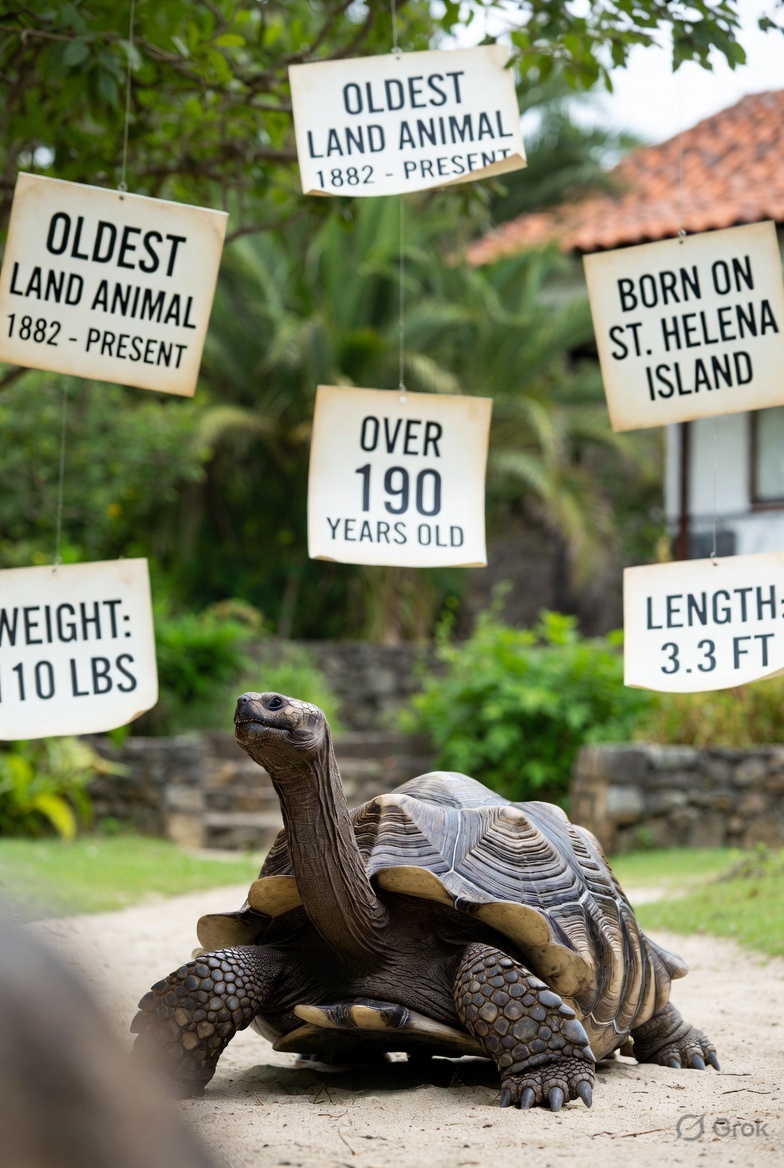
The World’s Oldest Living Land Animal, Jonathan the Seychelles Giant Tortoise, A Living Legend
On a remote island in the South Atlantic, a creature ambles slowly across a dewy lawn, his dark, weathered shell a testament to the passage of time. This is Jonathan, a Seychelles giant tortoise who carries the weight of nearly two centuries on his back. Officially recognized by Guinness World Records as the oldest known living land animal, Jonathan is not just a tortoise—he is a living piece of history, a gentle giant who has outlived generations and witnessed the transformation of the modern world.
Estimated Age and Origins
Estimated to have hatched around 1832 in the Seychelles (then part of British Mauritius), Jonathan is approximately 193–194 years old as of 2026. He was already fully mature—at least 50 years old—when gifted to Saint Helena’s governor in 1882. This conservative estimate means he could be even older. Guinness World Records recognizes him as both the oldest known living land animal and the oldest chelonian (turtle/tortoise) ever recorded, surpassing previous holders like Tu’i Malila (188–189 years).
His birth places him in the early Victorian era, before the widespread use of electric light, telephones, automobiles, or even the modern postage stamp.
Arrival on Saint Helena (1882)
In 1882, Jonathan arrived on the remote British Overseas Territory of Saint Helena as a gift to Sir William Grey-Wilson, who later became governor. Historical letters and photos confirm he arrived fully grown—a key detail used to back-calculate his age. He was settled in the lush grounds of Plantation House, the official residence of the governor, where he has lived ever since. He remained unnamed until the 1930s, when Governor Sir Spencer Davis gave him the name “Jonathan.”
Physical Characteristics and Subspecies
Jonathan belongs to the Seychelles giant tortoise (Aldabrachelys gigantea hololissa), a subspecies distinguished from the more common Aldabra giant tortoise (A. g. gigantea) by a broader, more flattened shell with raised scutes and brownish-grey coloration. Males can reach up to 4 feet (1.2 m) in carapace length and weigh 250–300+ kg (550–660+ lbs). His shell has remained virtually unchanged in size and appearance for over 140 years.
This subspecies is considered Extinct in the Wild in its pure form—extirpated from its original granitic Seychelles islands in the 1800s due to exploitation by sailors for food and oil. Only a handful of similar tortoises survive in captivity or reintroduced groups, making Jonathan genetically and historically precious.
Life at Plantation House
Jonathan roams freely on the expansive lawns of Plantation House, sharing his home with three other giant tortoises:
- David and Emma (arrived 1969, from Seychelles)
- Frederik (arrived 1991, originally thought female and named Frederika; now known male)
He has outlived 31 governors and 7 British monarchs (from Victoria to Charles III).
Age-Related Changes and Adaptations
Due to cataracts and age-related decline, Jonathan is blind and has lost his sense of smell, but his hearing remains sharp. He navigates by sound, responds to voices, and relies on memory to navigate his familiar surroundings. Despite these limitations, he maintains a hearty appetite and remains active.
Daily Care Routine
Jonathan’s daily routine is simple and low-intervention:
- Morning to Midday: Grazes on fresh grass, roaming freely with companions
- Sunbathing: Seeks sunlight to raise body temperature, stretching neck and legs in a distinctive spread-eagled posture
- Feeding Support: Hand-fed weekly with seasonal fruits and vegetables (apples, pears, bananas, carrots, cucumbers, cabbage, guava) to compensate for vision and smell loss
- Health Monitoring: Regular veterinary checkups; occasional gentle shell cleaning
His longevity stems from a stress-free life, stable environment, slow metabolism, and minimal but effective human support.
Mating Behavior
Despite his extreme age, Jonathan retains a remarkably strong libido. He is frequently observed attempting to mate with Emma and occasionally Frederik—a behavior his longtime veterinarian describes as a sign of excellent health. This indiscriminate mounting (including same-sex attempts) is common in giant tortoises, reflecting an instinctual “mate whenever possible” strategy rather than human-like orientation.
No offspring have resulted—likely due to Frederik being male, possible age-related sterility, or natural low fertility in isolated individuals.
Historical Photographs: A Visual Timeline
1882–1886 (Earliest Known Photograph)
This black-and-white image shows Jonathan (left) grazing alongside another unnamed tortoise shortly after his arrival at Plantation House. Already fully mature at approximately 48 inches carapace length—identical to today—this photo provides crucial evidence supporting his estimated birth year of ~1832.
Circa 1900 (Boer War-Era Photograph)
A black-and-white photograph shows Jonathan in the foreground with a Boer prisoner and British guard standing nearby, taken during the Second Boer War (1899–1902) when Saint Helena housed over 5,000 Boer prisoners of war. This image symbolizes Jonathan’s quiet witness to history—unchanged amid human drama.
1914
A photograph shows two giant tortoises side-by-side at Plantation House. Jonathan (estimated age ~82) is believed to be the larger of the two; the other, a female said to have originated around 1776, reportedly lived until 1918.
1947 (Royal Visit)
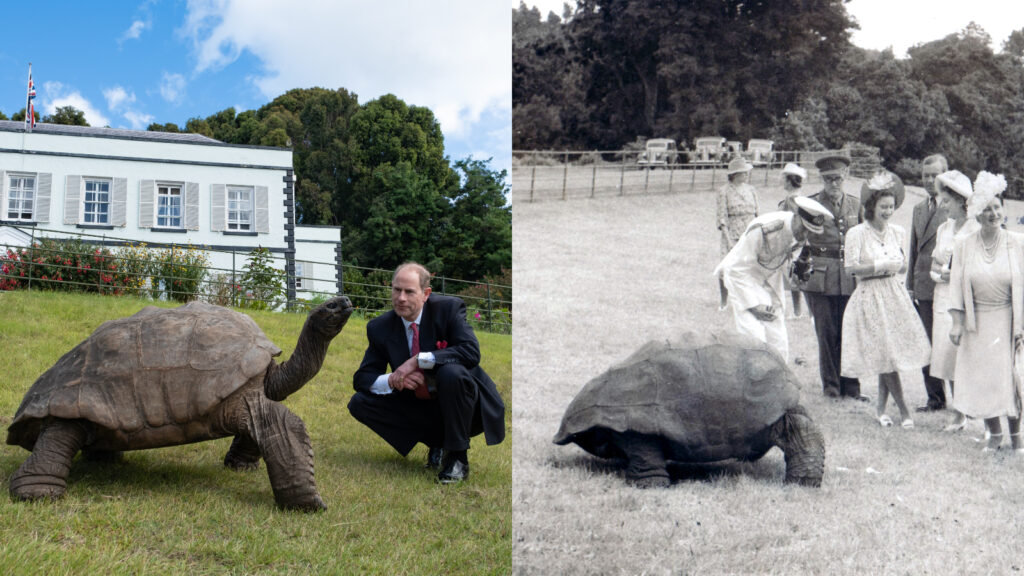
On April 29, 1947, the British royal family (King George VI, Queen Elizabeth the Queen Mother, Princess Elizabeth—the future Queen Elizabeth II—and Princess Margaret) visited Saint Helena. A 21-year-old Princess Elizabeth is shown interacting with Jonathan (then ~115 years old) on the Plantation House lawns.
1948
A black-and-white group photo shows Jonathan with local children posing around him. At ~116 years old, he appears identical to earlier images.
2024 (Prince Edward Visit)
On January 23, 2024, Prince Edward, Duke of Edinburgh (son of Queen Elizabeth II), visited Saint Helena and met Jonathan (then ~191–192 years old). Photos show the Duke crouching close to the tortoise on the same lawns where his mother had stood 77 years earlier. Media outlets worldwide published side-by-side comparisons of the 1947 and 2024 images, emphasizing Jonathan’s enduring presence across generations of the royal family.
What Jonathan Has Witnessed
While plodding along at his famously slow pace, Jonathan has outlived:
- Eras: The Victorian era to the digital age
- Inventions: Telephone (1876), light bulb (1879), airplane (1903), television, internet, smartphones
- Events: Two world wars, moon landings, rise and fall of empires, decolonization
- Monarchs: 7 British monarchs (Victoria to Charles III)
- Governors: 31 of Saint Helena
- U.S. Presidents: 40+
On Saint Helena specifically, Napoleon Bonaparte’s exile ended just before Jonathan’s arrival (Napoleon died in 1821; his body was removed in 1840).
Recognition and Legacy
Jonathan gained wider attention in the late 2000s when historical photos surfaced, and in 2022, Guinness World Records officially recognized him as the oldest known living land animal and oldest chelonian ever recorded.
He has an official birthday celebration every December 4, is featured on Saint Helena’s 5-pence coins and stamps, and has become a major tourist attraction.
Reproduction in Seychelles Giant Tortoises
Mating and Courtship
Season: Primarily February to May (warmer, wetter periods in the Seychelles/Indian Ocean region)
Behavior:
- Males approach females with head bobbing, circling, nudging, and vocalizations (deep grunts, huffs, trumpeting calls)
- Mounting involves climbing atop the female, using a concave plastron (lower shell) for leverage
- Males often mount multiple partners (polygynandry system); same-sex mounting is common
Nesting and Egg-Laying
- Clutch size: 9–25 eggs per clutch (typically)
- Eggs: Rubbery, spherical, ~2 inches (5 cm) in diameter, white or pale
- Nesting process: Females dig shallow pits (~30 cm deep) in sunny, well-drained areas; no further parental care
- Multiple clutches: 1–2 per season possible
- Fertility: Often low (less than half fertile) due to age, genetics, or environment
Incubation and Hatching
- Period: Temperature-dependent, 3–8+ months (typically ~110–250 days)
- Sex determination: Temperature-dependent—warmer nests produce females, cooler nests produce males
- Hatching: Young emerge independently, fully independent from birth
- Survival challenges: High predation risk (rats, birds, crabs); low natural recruitment in some areas
Conservation Context
Low reproduction in some populations, aging demographics, and climate change pose challenges. Recent breakthroughs include the first successful artificial incubation in 2025 on Cousin Island, producing 13 healthy hatchlings from rescued eggs.
Giant Tortoise Courtship
General Courtship Sequence
Approach and Detection: Males actively seek females, often detecting chemical cues (musk/pheromones) from the female’s hind legs or cloacal area.
Pre-Mounting Displays:
- Head bobbing (rhythmic toward the female or rival males)
- Circling and nudging (gentle bites at legs/head/shell)
- Chasing (at “tortoise speed”), trapping females against obstacles
Mounting and Copulation:
- Male climbs atop female, propping forelegs on her shell’s front edge
- Neck fully extended for leverage and display
- Thrusting accompanied by loud vocalizations—deep bellows, grunts, roars, hisses, or trumpeting sounds
- Females may resist by walking away or dropping rear to block access
Species Comparisons
Galápagos Giant Tortoises (Chelonoidis spp.):
- More aggressive courtship, especially in saddleback subspecies
- Ritualized male-male dominance displays (facing off, rising on legs, neck extension, gaping mouths)
- Loud bellows during thrusting; ramming/nipping legs to immobilize females
- Peak season: February–June
Aldabra/Seychelles Giant Tortoises (Aldabrachelys gigantea):
- Generally gentler than Galápagos counterparts
- Loud bellows with thrusts; neck fully extended during mounting
- Females often resist actively
- Peak season: February–May
Conservation of Seychelles Giant Tortoises
Conservation Status
The main species, Aldabrachelys gigantea, is classified as Vulnerable on the IUCN Red List, reflecting its restricted natural range (mostly Aldabra Atoll), vulnerability to climate change, and concerns over low natural recruitment.
The morphologically distinct Seychelles form (A. g. hololissa) is considered Extinct in the Wild—extirpated from its original granitic Seychelles islands in the 1800s, with only a few dozen surviving individuals in captivity or small reintroduced groups.
Aldabra Atoll hosts the core wild population of ~100,000–150,000 individuals, protected as a UNESCO World Heritage Site since 1982.
Key Threats
- Climate change (sea-level rise threatening low-lying atolls)
- Low reproduction in some areas (aging populations reliant on longevity rather than new hatchlings)
- Historical exploitation, invasive species, and habitat degradation
Major Conservation Initiatives
Indian Ocean Tortoise Alliance (IOTA):
A Seychelles-based non-profit founded around 2018–2019, dedicated to the conservation and rewilding of Aldabra giant tortoises across the Western Indian Ocean region. IOTA positions tortoises as ecosystem engineers—grazing vegetation, dispersing seeds, enriching soil, and creating pathways that benefit other species.
Key Rewilding Projects:
- North Island (Flagship Project): In March 2025, 50 Aldabra giant tortoises (formerly captive) were released after quarantine, health checks, and microchipping. Population now ~170–200+ individuals in sanctuary areas.
- Fregate Island: Home to one of the largest rewilded herds (>3,000 individuals)
- Curieuse Island: Regular censuses track populations; recent baby discoveries renew hope for natural recruitment
- Other islands: Desroches, Aride, and others have growing herds
Artificial Incubation Breakthrough (2025):
Nature Seychelles and collaborators achieved the first successful artificial incubation of Aldabra giant tortoise eggs, producing 13 thriving hatchlings. This trial addresses low natural hatching rates and could scale up for population boosts.
Comparison: Galápagos Giant Tortoise Conservation
Giant tortoise conservation in the Galápagos is one of the most successful wildlife recovery programs globally, with over 10,000 juveniles rewilded across islands in recent decades. Led by the Galápagos National Park Directorate in partnership with the Charles Darwin Foundation, Galápagos Conservancy, Island Conservation, and others, efforts focus on captive breeding, invasive species removal, habitat restoration, and reintroductions.
Current Status (as of 2026)
- Overall population: Recovered significantly; some islands now self-sustaining
- IUCN classifications: Six taxa Critically Endangered, three Endangered, three Vulnerable, two Extinct (though hybrids carry genetics)
- Key success: Española Island grew from ~15 survivors in the 1960s to >3,000 naturally reproducing individuals today
Major Initiatives
Iniciativa Galápagos:
A flagship program to restore tortoises to historical ranges, including captive breeding, repatriation, habitat restoration, and research.
Floreana Ecological Restoration Project:
The largest-ever restoration in Galápagos. In February 2026, 158 juvenile tortoises (hybrids with 40–80% Floreana ancestry) were released—the first return in over 180 years. This followed a 2017 “back-breeding” program using 23 hybrids discovered on Isabela Island, genetically closest to the extinct Floreana lineage (Chelonoidis niger). Over 600 hatchlings were produced by 2025, with phased releases planned annually.
Breeding and Repatriation:
Three main breeding centers raise hatchlings until predator-resistant (~8–15 years old) before release. Española captive breeding ended ~2020 due to success; focus shifted to habitat restoration and natural recruitment.
Lonesome George: A Symbol of Extinction
Lonesome George was the last known individual of the Pinta Island giant tortoise subspecies (Chelonoidis niger abingdonii), making his story a poignant symbol of extinction and conservation.
- Hatching: Estimated around 1910 on Pinta Island
- Rediscovery: Found alone on November 1, 1971—the sole survivor of his subspecies
- Relocation: Moved to the Fausto Llerena Breeding Center on Santa Cruz Island in 1972 for protection and breeding attempts
- Breeding attempts: Paired with females from similar subspecies; eggs laid in 2008 were all infertile
- Death: Died on June 24, 2012, at approximately 101–102 years old (middle-aged for giant tortoises)
- Legacy: His taxidermied body is displayed at the Charles Darwin Research Station as a reminder of extinction risks. His story sparked renewed global focus on Galápagos conservation and inspired efforts to “resurrect” lost lineages via hybrids.
Conclusion
Jonathan’s life story is one of extraordinary endurance, quiet resilience, and unwitting historical witness. While wars raged, empires rose and fell, and technology reshaped everything, he simply kept ambling on his dewy lawn—a gentle, unchanging figure amid explosive human progress.
His existence is a humbling reminder of deep time versus our fleeting pace. Thanks to dedicated caretakers and conservation efforts, this gentle ambassador of longevity continues to thrive, proving that even in the slowest of steps, a life can cover an extraordinary distance.






Leave a Reply