


Building on the sustainable backyard systems with chickens, ducks, and rabbits, bees—particularly honeybees—offer one of the most powerful eco-services: pollination. While chickens scratch for pests and accelerate composting, ducks target slugs, and rabbits provide premium manure, bees focus on reproduction and abundance in the garden. Introducing a beehive (or encouraging native pollinators) creates a more productive, biodiverse space that complements animal-integrated gardening.
Bees are essential for about one-third of the food we eat, pollinating crops like fruits, vegetables, nuts, and seeds. In a backyard setting, they supercharge yields without chemicals or extra effort.
A couple of years back, my suburban backyard in the warmer parts of the U.S. (think zones where tropical vibes meet temperate gardening, like parts of Florida, southern Texas, or coastal California) was producing okay—but nothing spectacular. Tomatoes were spotty, squash vines produced a few fruits here and there, and my berry bushes seemed to hold back. I figured it was the usual culprits: inconsistent watering, competing pests, or just not enough pollinators buzzing around. Then I discovered stingless bees—tiny, gentle native pollinators from the Meliponini tribe—and decided to bring a hive into my garden. It turned out to be a game-changer. My plants are now bursting with life, yields are up, and the whole yard feels more vibrant and balanced.
Stingless bees aren’t your typical honeybees. They have no functional stinger, so they’re completely harmless around kids, pets, and bare skin—no protective suits or smoke required. These small bees (often just 3–8 mm long, with shiny black or metallic bodies) form compact colonies in man-made wooden boxes or logs, a practice called meliponiculture that’s been done for centuries in tropical regions. While true native stingless bees thrive in Central and South America (and extend into southern Mexico), small introduced or relic populations have been documented in isolated spots in the southern U.S., like parts of California or extreme South Texas. In suitable warm climates, enthusiasts sometimes maintain them in greenhouses or protected setups for pollination.
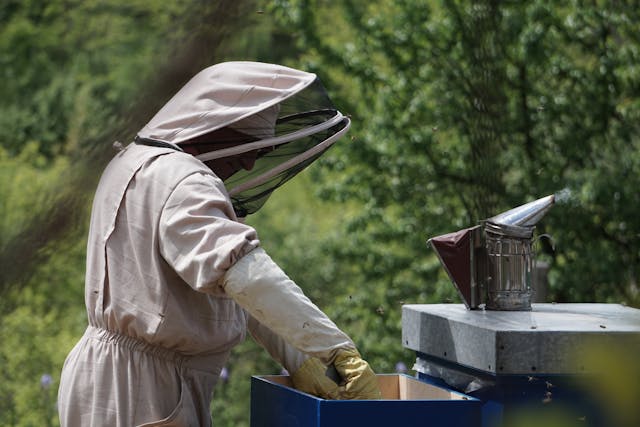
I sourced a healthy colony from a specialist supplier or local meliponiculturist (availability varies by state—check regulations, as importation is restricted to prevent disease spread, and some areas limit non-native species). The hive came in a compact, ventilated wooden box—about the size of a large shoebox—with an established nest including brood, pollen pots, and honey stores. I placed it in dappled shade, facing southeast for morning warmth, elevated on a stand about 3–4 feet off the ground to avoid ants and make observation easy. Within a week, the foragers were out exploring my flowers.
The results were dramatic. These bees are powerhouse pollinators, especially for crops with small or tricky flowers that bigger bees might skip. They work efficiently in a variety of conditions, including overcast days or high humidity, and they target a broad range of plants.
In my garden:
- Tomatoes set more fruit clusters, with fuller, more uniform shapes.
- Cucumbers, zucchini, and melons produced reliably—no more blossom-end rot from poor pollination.
- Peppers and eggplants yielded bigger, healthier harvests.
- Berry bushes (blueberries, strawberries) flowered and fruited more abundantly.
- Herbs like basil, cilantro, and mint attracted even more beneficial insects.
Research backs this up: stingless bees excel at pollinating crops like tomatoes, peppers, squash, berries, and tropical fruits. Their “buzz pollination” technique (vibrating flowers to release pollen) is particularly effective for many nightshades and berries, often outperforming honeybees in specific cases.
Beyond pollination, the perks keep coming. Stingless bees produce a special, runny honey—higher in moisture, with tangy, floral notes and known antioxidant and antibacterial properties in traditional uses. Colonies yield modest amounts (a few hundred ml to a liter per year), harvested gently with a syringe without harming the bees. It’s perfect for drizzling on yogurt, in tea, or as a natural sweetener. They also create propolis-like resins with potential wellness benefits.
The hive boosted overall biodiversity too—more butterflies, hoverflies, and birds showed up, turning my yard into a thriving mini-ecosystem.
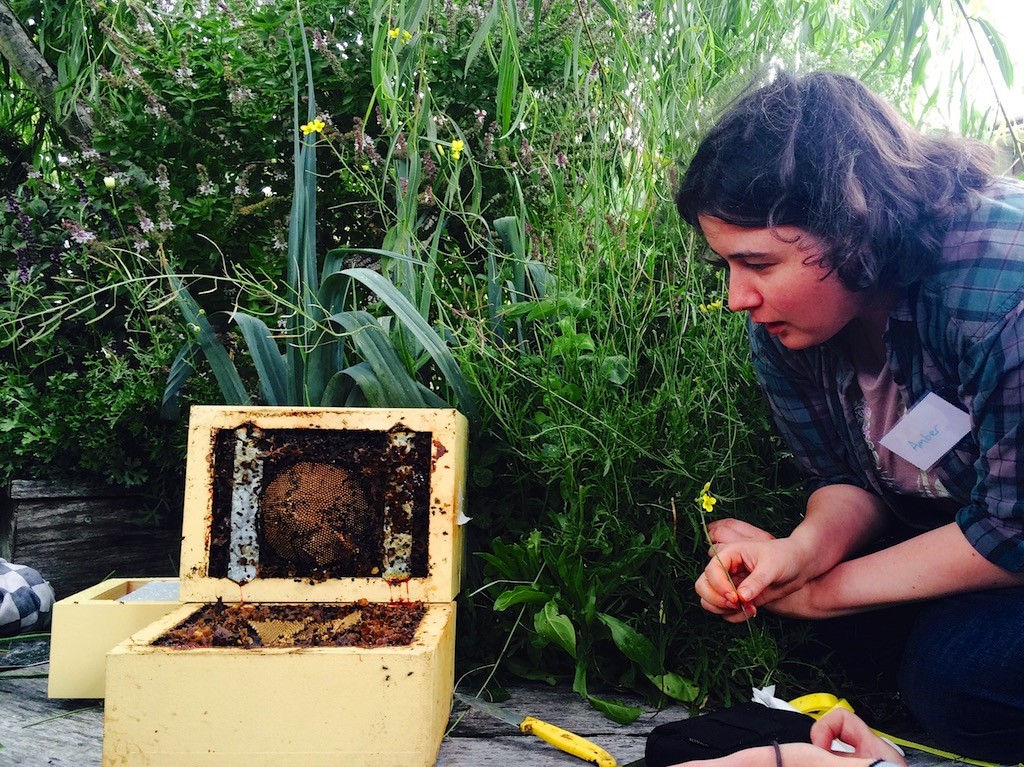
Maintenance is minimal compared to honeybee keeping. No heavy gear, no aggressive defense behaviors. I check monthly: ensure good ventilation, provide sugar-water during dry spells if natural forage dips, and guard against ants with water moats or barriers. When colonies strengthen, they can be split to start new hives for friends or expansion.
Primary Benefit: Superior Pollination Power
Honeybees (and native bees) transfer pollen from flower to flower as they collect nectar and pollen, enabling fertilization and fruit/seed production. In a home garden, this translates to:
- Higher yields and better quality from fruiting plants like tomatoes, cucumbers, zucchini, strawberries, apples, plums, and berries.
- Larger, more uniform fruits and vegetables.
- Improved seed production for self-sowing plants or saving seeds.
Bees forage up to 3 miles, so one backyard hive benefits not just your garden but neighboring yards, community plots, and local wildflowers. This creates a ripple effect for biodiversity—healthier plants support more insects, birds, and wildlife.
A thriving pollinator population also makes gardens more resilient: well-pollinated, vigorous plants resist pests and diseases better, reducing the need for interventions.
How Bees Fit into Composting and Pest Control Systems
Bees don’t directly contribute to composting like rabbits (with their “cold” manure) or chickens (who turn piles). Their role is indirect: by boosting plant growth and diversity, they increase organic matter (more leaves, flowers, and crop residues) for your compost heap.
For pest control, bees support a balanced ecosystem. A diverse, pollinator-rich garden attracts beneficial insects (ladybugs, hoverflies, predatory wasps) that prey on pests. Healthy, robust plants from good pollination are less vulnerable to infestations. While bees themselves don’t hunt pests, their presence signals (and helps create) a low-chemical environment where natural predators thrive.
Note: Avoid pesticides—many harm bees. Opt for integrated pest management (IPM) with companion planting, barriers, or the animals already in your system (e.g., ducks for slugs, chickens for grubs).
Backyard Beekeeping: Practical Considerations
Starting with honeybees involves:
- A hive (Langstroth or top-bar for beginners).
- Local regulations (check Hyderabad/Telangana rules on urban beekeeping).
- Basic equipment, protective gear, and knowledge (join local beekeeping groups or courses).
- Ongoing care: monitoring for diseases, mites, and providing water/supplemental forage if needed.
Advantages include fresh honey, beeswax for candles or balms, and educational joy—observing hive life is fascinating.
However, beekeeping requires commitment and isn’t for everyone. Stings are possible (though rare with calm handling), initial costs add up, and honeybees (often non-native) can sometimes compete with local native bees, which are highly efficient pollinators.
For lighter involvement, plant bee-friendly flowers (marigolds, lavender, sunflowers, borage, salvia) and install native bee houses to boost pollination without full beekeeping.
Synergy in the Eco-Backyard
Combine bees with your chickens, ducks, and rabbits for a full-circle system:
- Bees pollinate → more abundant crops and waste.
- Animals process scraps and pests → richer compost.
- Compost fertilizes plants → stronger blooms for bees.
This closed-loop approach minimizes waste, eliminates synthetic inputs, and enhances self-sufficiency. In places like Hyderabad, where urban gardens face heat and water challenges, diverse pollinators help create resilient, productive spaces.
Asynchronous Muscle Mechanisms in Insects: Powering Ultrafast Flight and Buzz Pollination
Asynchronous muscles represent one of nature’s most elegant solutions to achieving extremely high contraction frequencies in insects. Found in the indirect flight muscles (IFMs) of about three-quarters of flying insect species—including bees, flies, mosquitoes, beetles, and many wasps—these muscles allow wingbeat rates far beyond what a typical neuromuscular system could sustain through direct, one-to-one neural control. In bees, for example, asynchronous muscles enable wingbeats at 150–250 Hz during flight and even higher-frequency vibrations (often 200–400 Hz) during behaviors like buzz pollination (sonication).
Buzz Pollination: How Bees Use Vibrations to Unlock Hidden Pollen
Buzz pollination, also known as sonication, is a specialized pollination technique where certain bees generate high-frequency vibrations to release pollen from flowers that tightly hold it inside their anthers. This method is essential for many plants that don’t freely release pollen through wind, nectar attraction alone, or simple contact—making it a key interaction in ecosystems and agriculture.
Unlike standard pollination where bees brush against open anthers or collect loose pollen, buzz-pollinated flowers have poricidal anthers: tubular structures with small pores or slits at the tip (or sometimes along the sides). The pollen inside is smooth, dry, and firmly attached, often inaccessible to insects without mechanical force. Plants use this strategy to control pollen release, ensuring it’s only given to efficient pollinators and reducing waste.
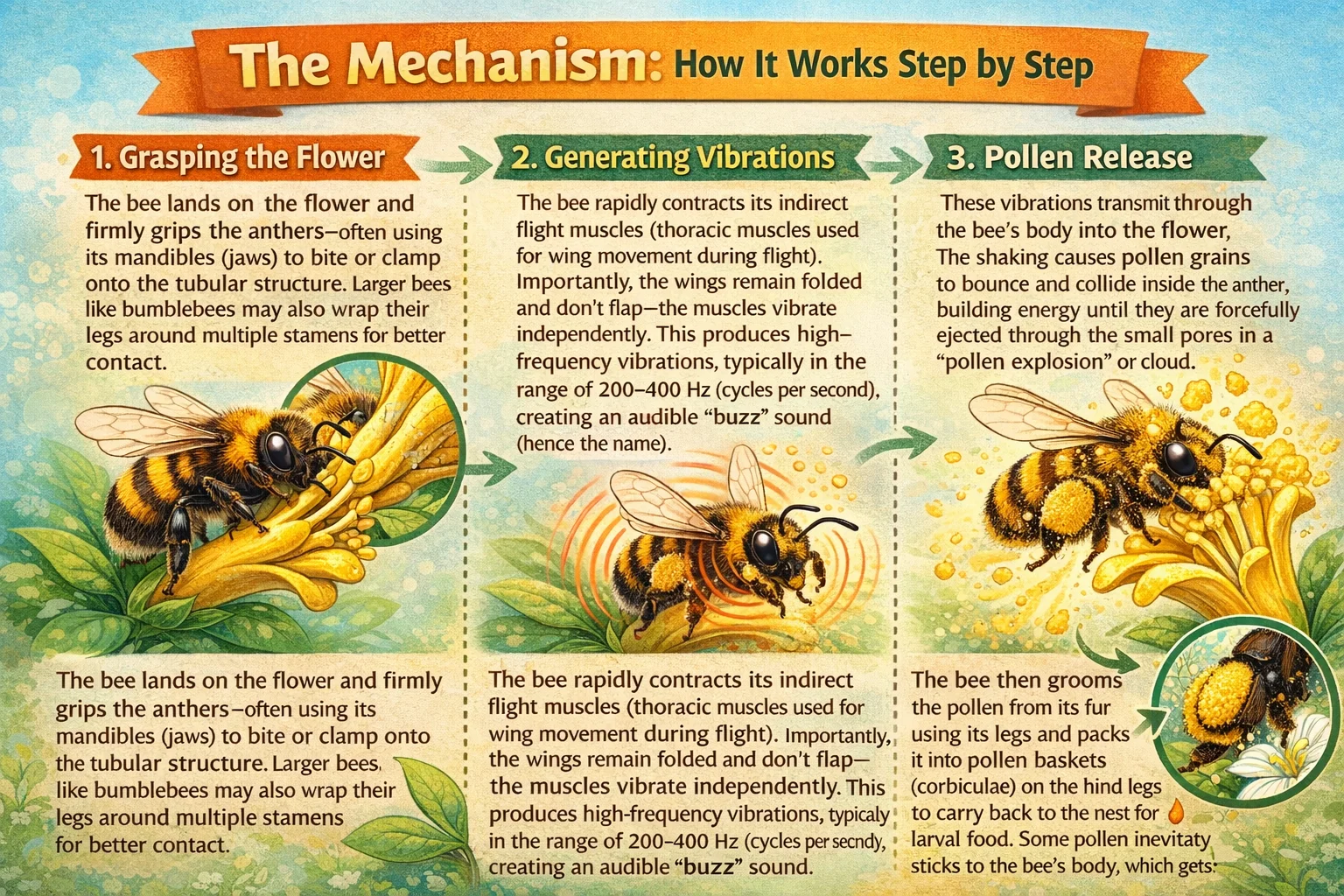
The Mechanism: How It Works Step by Step
- Grasping the Flower The bee lands on the flower and firmly grips the anthers—often using its mandibles (jaws) to bite or clamp onto the tubular structure. Larger bees like bumblebees may also wrap their legs around multiple stamens for better contact.
- Generating Vibrations The bee rapidly contracts its indirect flight muscles (thoracic muscles used for wing movement during flight). Importantly, the wings remain folded and don’t flap—the muscles vibrate independently. This produces high-frequency vibrations, typically in the range of 200–400 Hz (cycles per second), creating an audible “buzz” sound (hence the name).
- Pollen Release These vibrations transmit through the bee’s body into the flower. The shaking causes pollen grains to bounce and collide inside the anther, building energy until they are forcefully ejected through the small pores in a “pollen explosion” or cloud. The pollen coats the bee’s body, especially the thorax and legs.
- Collection and Grooming The bee then grooms the pollen from its fur using its legs and packs it into pollen baskets (corbiculae) on the hind legs to carry back to the nest for larval food. Some pollen inevitably sticks to the bee’s body, which gets transferred to the stigma (female part) of the next flower visited—achieving pollination.
This process is energetically demanding—it raises the bee’s body temperature and requires precise muscle control—but it’s highly efficient for accessing otherwise locked pollen.
Which Bees Can Do It?
Not all bees have this ability. Honeybees (Apis species) cannot perform true buzz pollination because they lack the necessary muscle control or behavior for effective sonication. Instead, they rely on other methods and are less effective for these plants.
Bees capable of buzz pollination include:
- Bumblebees (Bombus species) — among the most proficient and well-studied.
- Many solitary bees (e.g., genera like Augochloropsis or carpenter bees).
- Some stingless bees (Meliponini tribe), particularly in genera like Melipona, which use vibrations for certain crops.
Plants That Rely on Buzz Pollination
Over 20,000 plant species depend on this technique, including many economically important crops:
- Tomatoes (Solanum lycopersicum)
- Peppers and eggplants (other Solanum species)
- Blueberries, cranberries, and other Vaccinium berries
- Potatoes
- Kiwifruit
- Eggplants
- Some beans and nightshades
These plants often show poor fruit set without buzz pollinators, which is why commercial greenhouses frequently use managed bumblebee colonies for tomatoes and berries.
Why It Matters
Buzz pollination ensures better fruit quality, higher yields, and more uniform produce in crops that would otherwise struggle with inadequate pollination. In natural ecosystems, it supports biodiversity by favoring specialized bee-plant relationships. As pollinator populations face challenges, understanding and supporting buzz-capable bees (through habitat preservation or managed pollination) becomes increasingly important.
In short, buzz pollination is nature’s clever workaround for “locked” pollen—turning a bee’s flight muscles into a precise pollen-shaking tool. Next time you hear a low, vibrating hum in your tomato patch or blueberry bush, it’s likely a bee hard at work unlocking the next generation of fruit!
Synchronous vs. Asynchronous Muscle Control
Most muscles, including those in vertebrate skeletal systems and synchronous insect flight muscles (found in larger insects like dragonflies, locusts, or butterflies), operate synchronously (neurogenically):
- Each contraction requires a nerve impulse.
- One neural signal → one muscle twitch.
- Frequency is limited by the nerve’s refractory period and calcium cycling speed, capping wingbeats at roughly 100 Hz or less.
Asynchronous muscles (myogenic) break this limit:
- A single low-frequency neural impulse releases calcium, maintaining a constant elevated level in the sarcoplasm (with minimal sarcoplasmic reticulum needed).
- Once “primed” by calcium, the muscle oscillates autonomously through mechanical feedback—no additional nerve impulses are required per cycle.
- One neural signal can trigger multiple (often 10–20 or more) contraction-relaxation cycles.
- Wingbeat frequency emerges from the interplay of muscle properties, thoracic exoskeleton resonance, wing inertia, and aerodynamics.
This decoupling makes asynchronous flight highly efficient: myofibrils occupy a large volume (~50–60% in bees), mitochondria dominate energy production (~40%), and sarcoplasmic reticulum is reduced (~4%), optimizing for sustained high-power output with low neural overhead.
The Core Mechanism: Delayed Stretch Activation (and Shortening Deactivation)
The key physiological property enabling asynchrony is delayed stretch activation (SA), sometimes called stretch-induced activation:
- When one set of antagonistic muscles (e.g., dorsal longitudinals for downstroke) contracts, it deforms the rigid-but-springy thorax, stretching the opposing set (e.g., dorsoventrals for upstroke).
- This stretch triggers a rapid, delayed rise in tension in the stretched muscle—even under constant calcium levels.
- The stretched muscle then contracts forcefully, shortening and stretching the antagonist in turn.
- This creates a self-sustaining oscillatory cycle: stretch → delayed activation → contraction → shortening → deactivation → stretch of the other side → repeat.
Shortening deactivation complements this: rapid shortening reduces force output, allowing the cycle to continue smoothly without “locking” in contraction.
The delay in SA (typically a few milliseconds) is crucial—it times the force rise to reinforce the oscillation rather than dampen it. The thorax acts like a resonant spring-mass system, tuning the frequency to match natural resonance for maximal efficiency.
In bees and other asynchronous fliers:
- During flight, the cycle drives full wing strokes.
- For non-flight vibrations (e.g., sonication), bees fold their wings, decoupling them from the thorax motion. This alters muscle balance (e.g., higher activity in dorsal longitudinal muscles, closing the scutal fissure), producing smaller-amplitude, higher-frequency thoracic vibrations transmitted through the body to flowers.
Why It Works So Well for Bees and Buzz Pollination
In buzz-pollinated plants (tomatoes, blueberries, peppers), pollen is trapped in poricidal anthers. Bees grip the flower and activate their IFMs without flapping wings. The asynchronous mechanism allows precise, high-frequency vibrations (often higher than flight buzzes) to shake pollen free efficiently. The same stretch-activation machinery powers both flight and these targeted buzzes, with bees modulating frequency, amplitude, and muscle recruitment ratios for different tasks.
Evolutionary and Biomechanical Advantages
Asynchrony evolved convergently in advanced insect orders, enabling tiny bodies to achieve high power output and maneuverability. It minimizes energy wasted on calcium pumping and neural signaling, channeling ATP directly into mechanical work. While demanding (high metabolic rate), it supports feats like mosquito wingbeats >800 Hz or bee sonication bursts.
In short, asynchronous muscle mechanisms turn the insect thorax into a self-oscillating powerhouse. Through delayed stretch activation, a single neural “on” switch unleashes rapid, resonant contractions—fueling not just flight but the precise vibrations that unlock pollen treasures in countless flowers. This adaptation showcases how biomechanics and evolution collaborate to push physiological limits!
Asynchronous Muscles in Flies: The Key to Ultrafast Wingbeats
Flies (order Diptera), including common houseflies, fruit flies (Drosophila melanogaster), mosquitoes, and hoverflies, rely on asynchronous indirect flight muscles (IFMs) to achieve some of the fastest wingbeat frequencies in the animal kingdom. This specialized muscle type allows flies to flap their wings at rates far exceeding what traditional neuromuscular control could sustain—often 150–250 Hz in fruit flies and up to 800+ Hz in tiny midges or mosquitoes—enabling agile, precise flight maneuvers essential for evasion, hovering, and rapid escapes.
How Asynchronous Muscles Work in Flies
Like other asynchronous fliers (bees, beetles, etc.), fly IFMs are indirect: they don’t attach directly to the wings but deform the rigid, spring-like thorax exoskeleton. The two main antagonistic muscle sets are:
- Dorsolongitudinal muscles (running front-to-back) — power the downstroke.
- Dorsoventral muscles (running top-to-bottom) — power the upstroke.
These muscles operate asynchronously (myogenically): mechanical events decouple from neural signals. Low-frequency nerve impulses (often just 3–6 Hz in Drosophila) release calcium into the sarcoplasm, maintaining a steady elevated level that “primes” the muscle without needing rapid calcium cycling. Once primed, the muscles oscillate autonomously through delayed stretch activation (SA) and shortening deactivation (SD):
- When one muscle contracts, it stretches the antagonist via thoracic deformation.
- The stretch triggers a delayed rise in tension (SA) in the stretched muscle, causing it to contract forcefully.
- This contraction shortens the muscle and stretches the opponent, repeating the cycle.
- Shortening reduces force (SD), preventing lock-up and allowing smooth oscillation.
The thorax acts as a resonant spring-mass system: wingbeat frequency matches the natural mechanical resonance of the thorax, wings, and air load, rather than neural timing. This “distributed processing” offloads control from the brain, freeing neural resources for steering and sensory integration.
In flies, the system is highly tuned:
- Wingbeat frequencies typically range from ~185–220 Hz in Drosophila (adjustable by small changes in neural impulse rate, e.g., 185 Hz at 3 Hz impulses to 195 Hz at 5.5 Hz).
- Calcium modulates power output: higher sarcoplasmic Ca²⁺ recruits more cross-bridges, increasing force and allowing fine control of lift, thrust, or speed via visual or mechanosensory cues.
- The muscles feature fibrillar structure, minimal sarcoplasmic reticulum (for reduced calcium pumping), high passive stiffness, and low isometric force but high oscillatory power.
Fly-Specific Features and Comparisons
Flies (Diptera) show some distinct traits compared to other asynchronous fliers like bees:
- Faster kinetics in some aspects: Drosophila IFMs generate stretch-activated tension more rapidly (up to 9-fold faster than in large water bugs like Lethocerus), though overall power output balances out through species-specific optimizations.
- Lower relative thorax deformation: Asynchronous insects (including flies) deform the thorax less (0.4–0.7% of diameter) than synchronous ones (1.2–1.4%), with stiffer thoraxes (often 3–4 times stiffer dorsoventrally) and higher wing forces (up to 5–9× body weight vs. 2–3× in synchronous).
- No true buzz pollination specialization: While flies can vibrate thoraces, they lack the targeted high-amplitude sonication seen in bumblebees for poricidal flowers. Flies are generalist pollinators or use other strategies.
- Evolutionary note: Asynchronous flight evolved once at higher levels in major orders (including Diptera), with some reversions (e.g., in certain moths), but flies retain the full asynchronous capability.
Why It Matters for Flies
This mechanism enables extreme performance: tiny flies achieve maneuverability rivaling fighter jets, with wingbeats so rapid that vision and neural timing alone couldn’t keep up. It supports hovering, backward flight, and rapid turns. In research, Drosophila has become a model for studying asynchronous muscle at molecular and genetic levels, revealing roles of proteins like troponin and myosin isoforms in stretch activation.
In essence, asynchronous muscles transform the fly thorax into a high-frequency oscillator: neural “set points” tune calcium and resonance, while stretch-activation drives self-sustaining cycles. This elegant biomechanics explains why flies are among the most acrobatic fliers on Earth—proof that evolution can push muscle physiology to astonishing speeds!
Bees remind us that the most powerful eco-contribution is often the quiet work of reproduction and connection. Adding them (or supporting natives) elevates your backyard from a simple plot to a thriving, buzzing ecosystem—sweeter harvests included. Start small with pollinator plants, and consider a hive if you’re ready for the rewarding buzz!













Leave a Reply