

What is the Regenerative Pilot Program? / Farmer First regenerative agriculture pilot program
The Regenerative Pilot Program is a major new initiative from the U.S. Department of Agriculture (USDA), officially launched in December 2025 . It’s a $700 million program designed to help American farmers adopt regenerative practices that improve soil health, enhance water quality, and boost long-term productivity .
Key features of the program:
- Streamlined application: Farmers can now bundle multiple regenerative practices into a single application, rather than submitting separate applications for each conservation concern
- Funding sources: $400 million through the Environmental Quality Incentives Program (EQIP) and $300 million through the Conservation Stewardship Program (CSP)
- Whole-farm planning: Addresses all major resource concerns—soil, water, and natural vitality—under one conservation framework
- Outcome-based model: Focuses on measurable results rather than rigid process requirements
The program is explicitly tied to the “Make America Healthy Again” (MAHA) agenda, with the U.S. Department of Health and Human Services also investing in research on the connection between regenerative agriculture and public health .
Secretary of Agriculture Brooke Rollins described it as putting “Farmers First” by reducing administrative burdens and expanding access to new and beginning farmers .
NRCS regenerative agriculture / Regenerative agriculture USDA
The Natural Resources Conservation Service (NRCS) is the USDA agency administering the new Regenerative Pilot Program . This builds on NRCS’s nearly century-long mission—since the Dust Bowl of the 1930s—to help farmers conserve soil and water resources .
To keep the program grounded in practical solutions, NRCS is establishing a Chief’s Regenerative Agriculture Advisory Council that will meet quarterly to advise on implementation and help guide improvements .
The program also leverages the SUSTAINS Act to create public-private partnerships, allowing private companies to match federal investments in regenerative practices .
🌿 Core Principles of Regenerative Agriculture
5 principles of regenerative agriculture
/ What are the 5 principles of regenerative agriculture?
The five core principles of regenerative agriculture, highlighted at the Groundswell Agriculture Conference and widely referenced across the literature, are :
| Principle | Description |
|---|---|
| 1. Don’t disturb the soil | Minimize or eliminate tillage to preserve soil structure and protect fungal networks |
| 2. Keep the soil surface covered | Use cover crops or mulch to prevent erosion, moderate temperature, and feed soil life |
| 3. Keep living roots in the soil | Maintain living plants year-round to feed soil microorganisms through root exudates |
| 4. Grow a diverse range of crops | Increase biodiversity above and below ground through crop rotation and multi-species cover crops |
| 5. Bring grazing animals back to the land | Integrate livestock to cycle nutrients, stimulate plant growth, and improve soil through managed grazing |
These principles work together to restore degraded soils, rebuild soil organic matter, and strengthen overall soil health .
6 principles of regenerative agriculture
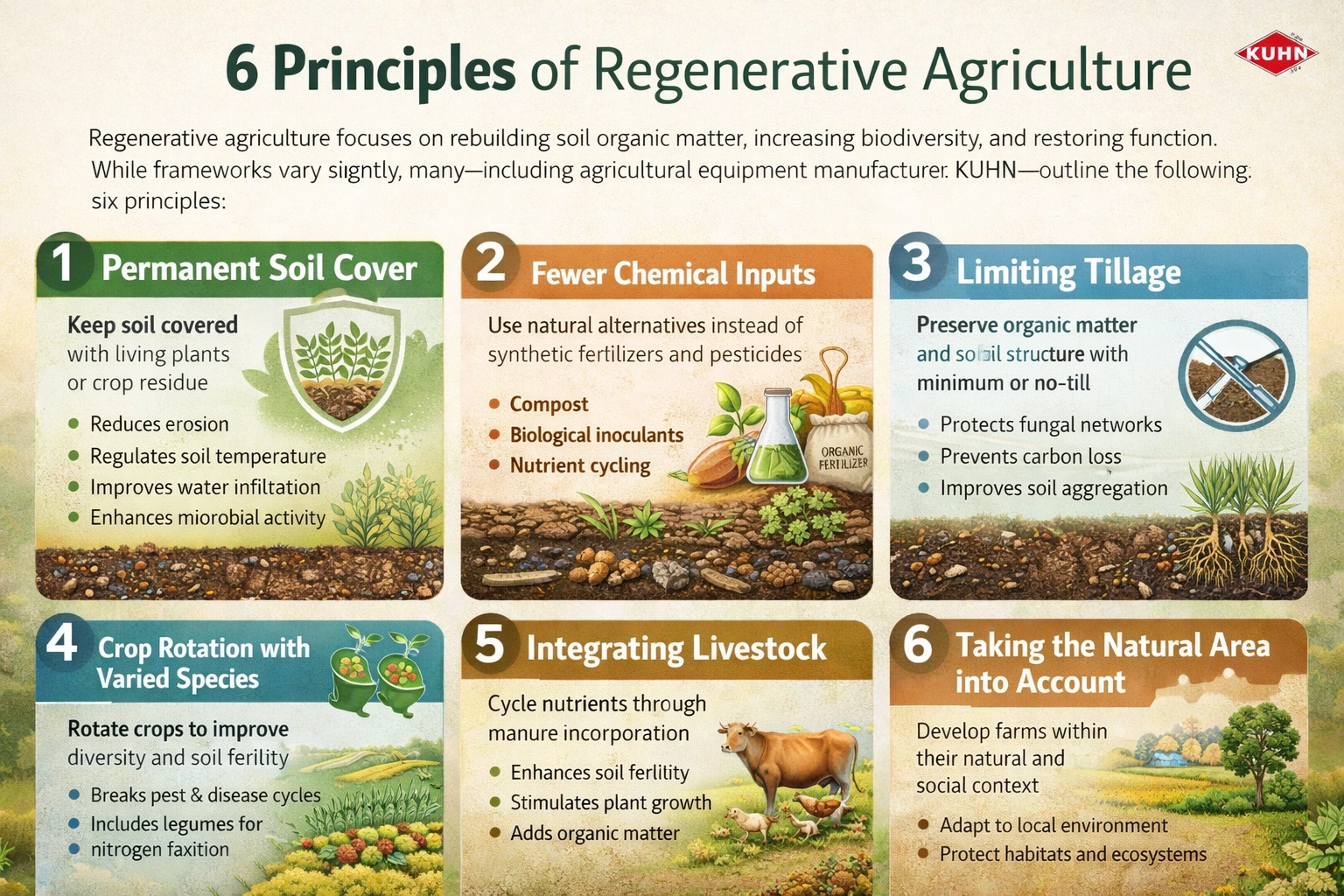
Some sources expand the framework to include six principles. According to agricultural equipment manufacturer KUHN, the six principles are :
- Permanent soil cover – Keeping soil covered at all times with living plants or crop residue
- Fewer chemical inputs – Reducing or eliminating synthetic fertilizers and pesticides in favor of natural alternatives
- Limiting tillage – Preserving organic matter and soil structure through minimum tillage or direct seeding
- Crop rotation with varied species – Alternating crops to prevent pest cycles and improve soil fertility
- Integrating livestock – Using animals to cycle nutrients through manure incorporation
- Taking the natural area into account – Developing farms within their regional ecological and social context
The sixth principle emphasizes that regenerative agriculture must be considered within a broader geographical and community context .
🌱 Soil Health and Farming Practices
What are the 4 R’s of soil health?
The 4 R’s are a nutrient management framework from Penn State Extension that helps farmers optimize fertilizer use while protecting soil health :
- Right fertilizer source: Match the fertilizer type to the specific crop needs
- Right rate: Apply the exact amount of fertilizer each crop requires—not too little, not too much
- Right time: Time applications so nutrients are available precisely when crops need them
- Right place: Place nutrients where crops can actually access and use them
This approach minimizes waste, reduces environmental pollution, and ensures efficient nutrient use .
How does regenerative farming improve soil health? / What are the practices of regenerative farming?
Regenerative farming improves soil health through several interconnected mechanisms :
Soil Structure Improvement:
- No-till practices preserve soil aggregates and prevent compaction
- Cover crop roots create channels for water infiltration and air exchange
- Organic matter accumulation improves soil tilth
Biological Activity Enhancement:
- Diverse crop rotations support varied soil microorganisms
- Living roots feed beneficial bacteria and fungi year-round
- Manure from grazing animals adds active biology to soil
Carbon Sequestration:
- Photosynthesis captures atmospheric CO₂
- Plant residues and root exudates become soil organic carbon
- Reduced tillage prevents stored carbon from escaping
Water Cycle Restoration:
- Increased organic matter improves water-holding capacity
- Better soil structure allows rainfall to infiltrate rather than run off
- Covered soil reduces evaporation
Nutrient Cycling:
- Deep-rooted crops pull nutrients from subsoil
- Biological activity makes nutrients available to plants
- Manure from livestock returns nutrients to the system
Regenerative agriculture examples
Several real-world examples demonstrate regenerative agriculture in action:
Syngenta’s REVERTE® Program (Brazil) :
- Aims to restore degraded pasturelands across Brazil
- To date, 280,000 hectares (larger than New York City and London combined) are being restored
- Spans 11 states and 3 biomes
- 92% of monitored farms saw yield increases between their first and second year, averaging 9% growth
- Target: 1 million hectares recovered by 2030
Woolworths New Zealand Study :
- Two-year research project with Gisborne grower LeaderBrand
- Tested cover cropping and compost application on intensive vegetable systems
- Found that cover cropping with vetch enabled a 34% reduction in nitrogen fertilizer for subsequent sweetcorn with no yield loss
- Measurable soil health gains within two years, especially on heavy clay soils
Gabe Brown’s Farm (North Dakota) [citation:previous discussion]:
- Pioneering regenerative operation using no-till, diverse cover crops, and integrated livestock
- Achieves production with zero fertilizer, fungicide, or pesticide applications
⚠️ Challenges and Critiques
Disadvantages of regenerative agriculture
While regenerative agriculture offers many benefits, researchers and practitioners have identified several challenges and disadvantages :
Economic Challenges:
- Transition costs: Farmers face potential yield dips and increased expenses during the multi-year transition from conventional to regenerative practices
- Premium uncertainty: Unlike organic certification, regenerative agriculture lacks consistent market premiums to offset transition costs
- Financial risk: The outcome-based nature means results aren’t guaranteed, creating uncertainty for farmers operating on thin margins
Practical Challenges:
- Labor intensity: Some regenerative practices, like managed grazing and diverse rotations, require more management attention
- Knowledge requirements: Successful implementation requires deep understanding of complex ecological interactions
- Input quality issues: The Woolworths study found that lower-grade compost contributed to weed pressure and reduced yields in year one
- Pest control limitations: Natural pest control methods may be less effective than synthetic options, especially during transition
- Vague definition: “Regenerative agriculture” lacks a universally accepted definition, leading to greenwashing concerns
- Measurement difficulty: Outcome-based approaches require complex monitoring and verification systems
- Global North origins: Critics note the term emerged from wealthy countries while overlooking farmers in the Global South who have practiced these methods for generations
- Systemic blind spots: The focus on farming practices may fail to address deeper social, economic, and political issues in our food system
Some researchers and advocates argue for embracing agroecology instead—a more holistic approach that connects science, practices, and social movements while addressing food system transformation comprehensively .
🧪 Basic Soil Terms
Cultivated soil
Cultivated soil refers to soil that has been prepared, tilled, and managed for growing crops. Cultivation typically involves:
- Mechanical disturbance (plowing, harrowing, disking)
- Addition of amendments (fertilizer, compost, lime)
- Planting and harvesting of crops
- Weed and pest management
Cultivation dramatically changes soil properties compared to uncultivated soil—for better or worse, depending on management practices.
Dirty soil
This informal term has two common meanings:
- Soil contaminated with pollutants (heavy metals, chemicals, industrial waste)—soil that is literally “dirty” in the sense of being unclean or hazardous
- Simple soil with high organic matter—in casual conversation, gardeners might say soil is “dirty” meaning it’s rich, dark, and full of organic material (though technically, all soil contains mineral particles, not just “dirt”)
In scientific contexts, “soil” refers to the living, dynamic medium that supports plant life, while “dirt” is often what you sweep off the floor—but in practice, the terms are used interchangeably in everyday gardening conversation.









Leave a Reply