


Coral reefs are often called the “rainforests of the sea,” and for good reason. They cover less than 1% of the ocean floor but support an estimated 25% of all marine life—a staggering concentration of biodiversity that rivals the Amazon itself. There’s just one problem: most coral reefs are surrounded by crystal-clear, nutrient-poor water that looks more like a desert than a jungle.
So how do these vibrant underwater cities flourish in what are essentially marine wastelands?
The answer, it turns out, is a constant, life-giving shower of fish pee.
The Paradox of the Reef
To understand why fish urine matters so much, you first have to understand the paradox at the heart of every coral reef.
Imagine trying to build a bustling metropolis in the middle of the Sahara Desert. You’d need to import food, water, and supplies constantly. That’s essentially what coral reefs do, except they can’t import anything. They’re stuck in what scientists call oligotrophic waters—ocean regions so low in nutrients that they’re often compared to biological deserts .
If you were to take a water sample from a reef in the Maldives or the Caribbean and test it for the nutrients that plants and animals need to grow—things like nitrogen and phosphorus—you’d find almost nothing. By all logic, reefs shouldn’t exist. They shouldn’t be able to support the technicolor explosion of life that divers travel thousands of miles to see.
Yet they do. And the secret is a “tight” nutrient cycle where nothing goes to waste and every resident plays a role in fertilizing the neighborhood .
The Fish: The Reef’s Internal Plumbing System
Enter the fish. Thousands of species, from tiny damselfish to massive groupers, spend their entire lives on the reef. They eat, they grow, and crucially, they excrete. And what they excrete is exactly what the reef needs to survive.
Fish waste comes in two primary forms:
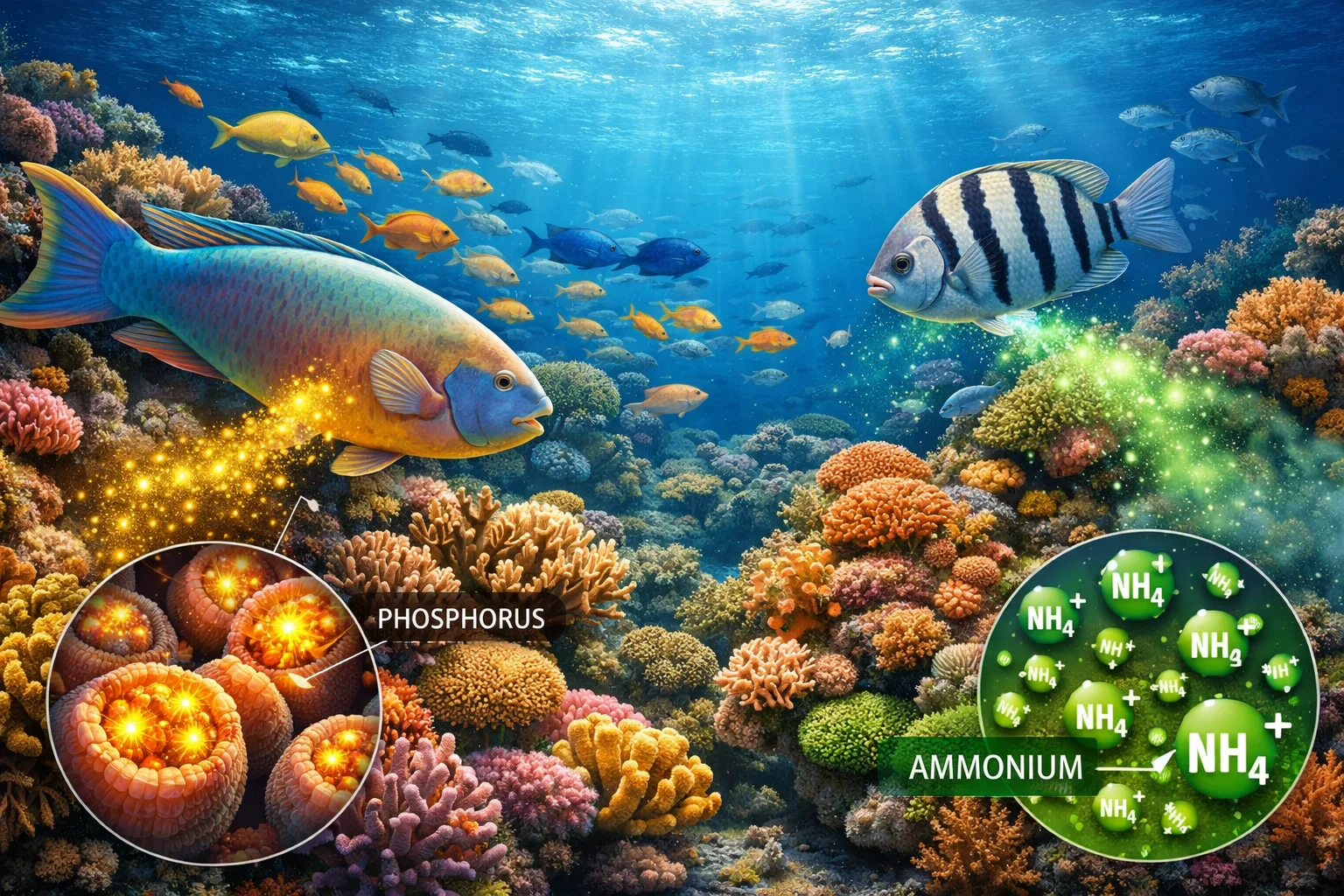
- Urine: Rich in phosphorus, a key nutrient that acts as a fertilizer for coral tissues and the symbiotic algae (zooxanthellae) that live inside them.
- Ammonium: Released through their gills as a byproduct of respiration, this provides a readily available source of nitrogen .
Think of it as a slow-release, precision-engineered fertilizer that’s being pumped out constantly by thousands of living dispensers. The fish consume resources from one part of the reef, swim to another, and release the nutrients in their waste—effectively spreading fertilizer across the entire ecosystem .
As one marine biologist bluntly put it, “If fish disappear, so does their pee. And if their pee disappears, the reef loses its primary source of nutrients.”
The Science: Proof in the Numbers
This isn’t just a charming theory—it’s been proven by rigorous science. A landmark study published in the journal Nature Communications in 2016 set out to measure exactly how much fish waste matters to coral reefs.
Researchers compared two types of reef ecosystems:
- Marine protected areas where fishing was banned and fish populations were healthy and abundant.
- Heavily fished reefs where large fish had been removed by decades of commercial and subsistence fishing.
The results were staggering. The reefs that had been depleted of large fish showed nearly 50% fewer crucial fish-derived nutrients like nitrogen and phosphorus .
Why such a dramatic difference? It comes down to a concept called nutrient biomass—the total amount of nutrients stored in the bodies of all the fish on a reef. When you remove large fish, you’re not just removing a few individuals. You’re removing massive nutrient reservoirs that have been built up over years of feeding and growth.
Size matters enormously in this equation. A single 50-pound grouper contains and excretes far more nutrients than fifty 1-pound fish. When fishing targets the big ones—which it almost always does—it disproportionately damages the reef’s fertilization system .
Lead researcher Jacob Allgeier of the University of Washington explained it simply: “If biomass is shrinking, there are fewer fish to pee. That means less fertilizer for the reef, slower growth, and a less resilient ecosystem.”
The Domino Effect: When the Plumbing Breaks
To understand why this matters, you have to look at what happens when the system breaks down.
On a healthy reef with abundant fish, the nutrient cycle works like this:
- Fish feed throughout the reef, consuming algae, plankton, and other small organisms.
- They digest their food, retaining what they need and excreting the rest.
- Their waste—both solid and liquid—releases nitrogen and phosphorus into the water column.
- Corals and their symbiotic algae absorb these nutrients, using them to grow, reproduce, and build the reef structure.
- The reef structure provides habitat for more fish, continuing the cycle.
It’s a perfect, self-sustaining loop.
But when overfishing removes the large fish, the loop breaks. Nutrient inputs drop by nearly half. Corals have less to eat. They grow more slowly. They’re less able to recover from bleaching events or storm damage. Algae, which don’t need fish waste to thrive, can take over. The reef begins to degrade.
And because there’s less habitat, the remaining smaller fish struggle to survive. Their populations drop, further reducing nutrient inputs. It’s a downward spiral that can transform a thriving reef into a barren wasteland in just a few decades .
The Unsung Heroes: Parrotfish and Their Sandy Contributions
While all fish contribute to reef fertilization, some species play particularly important roles. Parrotfish deserve special mention—not just for their pee, but for what they produce when they poop.
Parrotfish use their beak-like mouths to scrape algae off coral skeletons. In the process, they inevitably ingest chunks of coral rock. This material passes through their digestive system, where any organic nutrients are extracted, and emerges as fine white sand.
A single large parrotfish can produce over 800 pounds of sand per year. That’s right—much of the white sand on tropical beaches is actually parrotfish poop .
But beyond their famous sandy contributions, parrotfish also excrete nutrients that directly benefit the corals they graze around. By both fertilizing the reef and keeping algae in check, they’re essentially gardening their own habitat.
The Conservation Message: Save the Fish, Save the Reef
The discovery that fish urine is essential to reef health has profound implications for conservation.
For decades, marine protected areas were justified primarily on the grounds that they protect biodiversity and provide nursery habitats for commercially important fish. The fish-urine research adds a new, powerful argument: protecting fish biomass isn’t just about saving the fish—it’s about saving the reef itself.
When you establish a marine reserve and allow fish populations to recover, you’re not just creating a safe haven for marine life. You’re repairing the reef’s internal plumbing system. You’re restoring its ability to fertilize itself, grow, and recover from disturbances.
This is particularly important in an era of climate change, when corals face unprecedented threats from warming waters and ocean acidification. A well-fertilized reef with abundant fish has a much better chance of surviving and recovering from bleaching events than a nutrient-starved reef where the fish have been removed .
As Allgeier told reporters, “If we want to understand how to protect reefs, we have to understand the role of the animals that live on them. It’s not just about corals—it’s about the entire ecosystem, including the fish that pee on them.”
Beyond the Reef: The Global Nutrient Cycle
The fish-urine phenomenon on coral reefs is actually part of a much larger story about how animals shape nutrient cycles across the planet.
Scientists are increasingly recognizing that large animals—from whales in the ocean to wildebeest on land—play crucial roles in moving nutrients around the globe. Whales feed in deep water and release nutrient-rich feces near the surface, fertilizing plankton blooms. Salmon swim upstream, die, and decompose, transferring marine nutrients to freshwater and forest ecosystems. Sea birds transport phosphorus from the ocean to islands, where it fertilizes entire ecosystems .
Fish on coral reefs are doing the same thing on a smaller scale. They’re nutrient vectors, constantly redistributing the essential elements that life requires.
This understanding represents a fundamental shift in how ecologists view ecosystems. For much of the 20th century, the focus was on plants as the base of the food chain and animals as consumers. Now we know that animals aren’t just consumers—they’re also creators of the conditions that allow plants (and corals) to thrive.
The Future: Protecting the Reef’s Fertilizers
So what does this mean for the future of coral reefs?
It means that conservation efforts must expand beyond just protecting corals. It’s not enough to establish marine protected areas and hope for the best. We need to actively manage fish populations to ensure that the reef’s natural fertilization system remains intact.
This includes:
- Protecting large fish: Size matters for nutrient cycling. Fishing regulations should protect not just enough fish, but big fish.
- Maintaining species diversity: Different fish contribute different nutrients in different ways. Biodiversity matters for nutrient cycling.
- Restoring degraded reefs: In some cases, it may be possible to jump-start recovery by transplanting fish or artificially providing nutrients until natural populations recover.
- Addressing climate change: Warming waters kill corals directly, but they also disrupt the fish communities that fertilize them. Protecting reefs means addressing both local and global threats.
A New Appreciation for an Old Process
The next time you see a fish swimming over a coral reef, take a moment to appreciate what’s happening beneath the surface. That fish isn’t just a beautiful creature going about its daily business. It’s a living fertilizer dispenser, a nutrient vector, an essential piece of the reef’s survival machinery.
And when that fish pees—which it does constantly—it’s not just eliminating waste. It’s feeding the reef. It’s helping to build one of the most biodiverse ecosystems on Earth. It’s doing its part to create the “rainforests of the sea.”
The coral reef thrives because its residents never stop giving back. In the clearest, most nutrient-poor waters on Earth, life flourishes thanks to a constant, life-giving shower of fish pee.
It’s not the most glamorous job in the ocean. But it might just be the most important.
Key Takeaways
- Coral reefs thrive in nutrient-poor water because they operate on a tight, internal nutrient cycle.
- Fish are the key to this cycle, excreting nitrogen (through their gills) and phosphorus (in their urine) that corals need to grow.
- Overfishing disrupts this cycle, reducing available nutrients by nearly 50% on heavily fished reefs.
- Large fish matter most because they store and excrete disproportionately more nutrients.
- Protecting fish means protecting reefs—conservation efforts must focus on maintaining healthy, diverse fish populations with plenty of large individuals.












Leave a Reply