
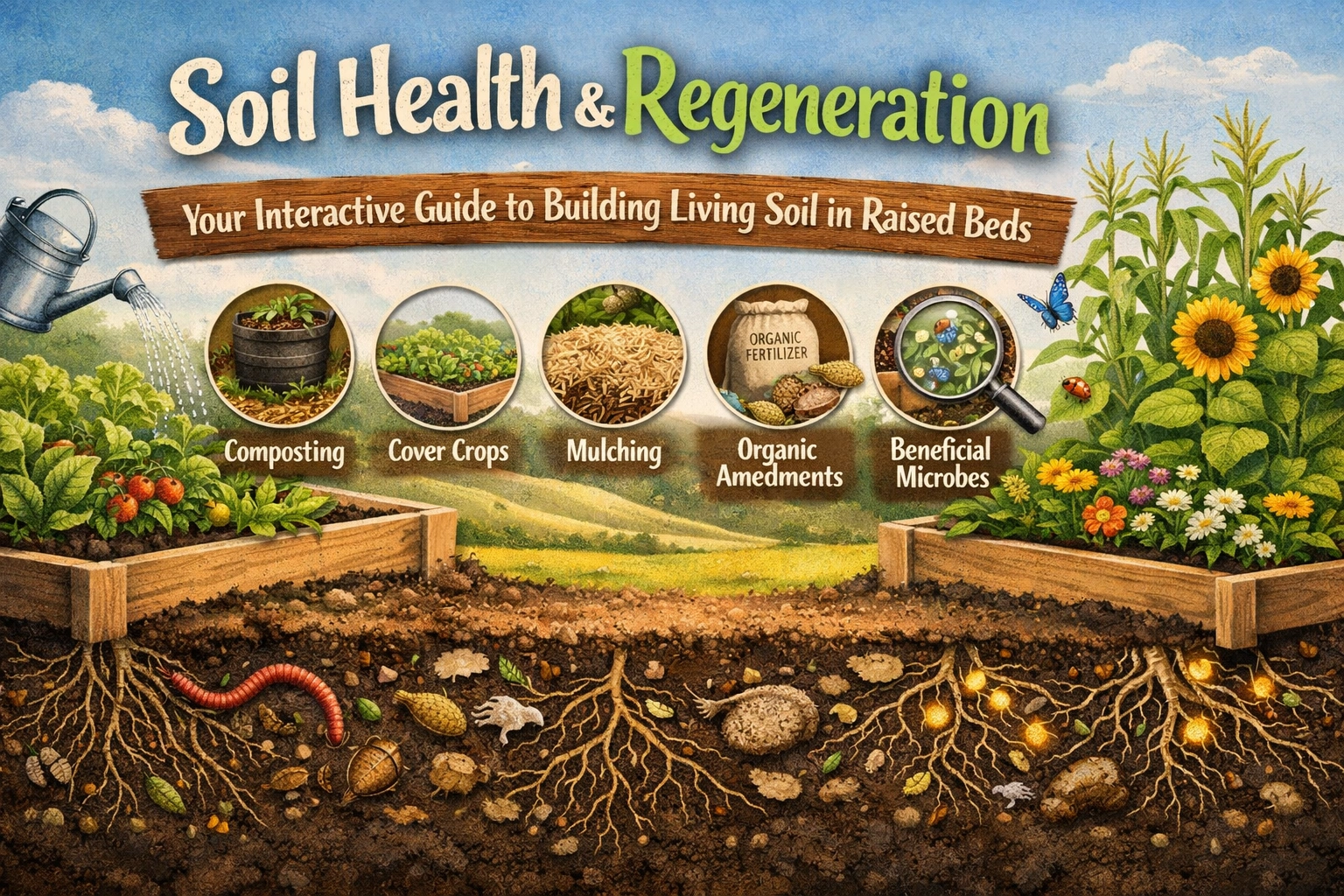
Healthy soil isn’t just “dirt” — it’s a living ecosystem teeming with billions of microbes, fungi, earthworms, and other organisms that work together to feed your plants, hold water, fight diseases, and even help fight climate change by storing carbon. In raised beds (perfect for backyards in the USA or urban spots in Hyderabad), you have total control to regenerate soil from day one — turning it into a powerhouse that produces bigger harvests with less effort over time.
This article turns soil science into an adventure. Grab a notebook: by the end, you’ll assess your soil and pick 3–5 regeneration practices to try!
Step 1: What Makes Soil “Healthy”? The Key Indicators Quiz! 🧠
Soil health has three pillars: physical, chemical, and biological. Rate your raised bed (or guess for a new one) on a scale of 1–5:
- Physical — Does soil crumble nicely (good structure/aggregation) or compact into hard clumps? Can you poke a finger in easily (no compaction)? Does water soak in fast without pooling (good infiltration)?
- Chemical — Is soil dark and rich-looking (high organic matter)? pH around 6.0–7.0 for most veggies? (Test kits are cheap!)
- Biological — Earthy smell? Wiggly worms when you dig? Visible fungi threads (mycorrhizae)? Lots of life = thriving biology!
Quick scoring:
- Mostly 4–5 → Your soil is regenerating nicely — focus on maintenance.
- 2–3 → Time to boost with regenerative practices.
- 1 → Major regeneration needed (compost + cover crops ASAP!).
Jot your scores — we’ll match practices next!
Step 2: Why Regenerate Soil? The Big Wins for Home Gardeners
Regenerative techniques mimic nature to rebuild soil instead of depleting it:
- More nutrients naturally → Less need for synthetic fertilizers.
- Better drought resistance → Soil holds 20,000+ gallons more water per acre-inch of organic matter.
- Fewer pests/diseases → Diverse microbes outcompete bad guys.
- Carbon storage → Your garden fights climate change!
- Long-term savings → Healthy soil means higher yields year after year.
In raised beds, regeneration is easier — no deep tillage needed, and you can layer amendments without disturbing structure.
Step 3: Top Regenerative Practices for Raised Beds
These are proven, home-scale methods from experts like the Soil Health Institute, USDA, and regenerative gardeners.
1. Minimize Disturbance (No-Dig Gardening) Avoid tilling/flipping soil — it kills fungi networks and releases carbon. In raised beds, use a broadfork or just hand-mix lightly. Pro move: Pull plants by roots (leave them to decompose) instead of yanking everything out.
2. Keep Soil Covered (Mulch & Cover Crops) Bare soil = erosion + weed invasion + lost moisture.
- Mulch with 2–4″ straw, shredded leaves, wood chips, or grass clippings (weed-free!).
- Plant cover crops (clover, buckwheat, rye, or daikon radish) in off-season — they prevent erosion, add nitrogen (legumes!), and build organic matter when chopped and dropped. Interactive challenge: Pick ONE cover — what will you sow this fall/winter?
3. Add Organic Matter Constantly (Compost is King!) Compost feeds microbes and builds structure. Top-dress 1–2″ every spring/fall.
- Homemade compost, worm castings, aged manure, leaf mold.
- In raised beds: “Lasagna” layer greens (kitchen scraps) + browns (leaves/cardboard) right on top.
4. Boost Biology with Diversity
- Plant diversity — Rotate crops + interplant (e.g., marigolds with tomatoes).
- Mycorrhizal fungi — Inoculate roots when planting (available as powders).
- Worm castings — Sprinkle for instant microbial boost.
5. Hugelkultur for Deep Regeneration (As we discussed earlier!) Bury logs/branches at the base — they become a long-term sponge + nutrient bank as they break down slowly.
Bonus for hot climates Heavy mulching + shade cloth keeps soil cooler and moister.
Step 4: Quick Regeneration Plan for Your Raised Bed
New bed?
- Fill with 60–70% quality topsoil/compost mix + 10–20% aeration (perlite/vermiculite).
- Add initial compost layer + mulch.
Existing bed needing recharge?
- Remove old mulch/plants.
- Top with 1–2″ compost + worm castings.
- Add amendments (e.g., kelp meal for minerals).
- Mulch thickly.
- Plant cover crop or succession veggies.
Yearly cycle: Fall = cover crops/compost. Spring = top-dress + plant. Summer = mulch + observe.
Your turn: Based on your quiz scores, list your top 3 practices to start with. Example: “Mulch + compost + cover crops!”
Final Tips to Make Soil Regeneration Stick
- Test soil yearly (pH, organic matter kits are affordable online).
- Water deeply but infrequently — encourages deep roots.
- Observe: Healthy soil smells earthy, drains well, and supports vigorous plants.
- Celebrate small wins — first earthworm sighting = victory dance!
Regenerating soil in your raised bed turns gardening into a partnership with nature. Over 3–5 years, you’ll notice dramatically better results with less work.
Quick share time: What’s your soil’s biggest “weak spot” right now? Or which practice excites you most?
Happy regenerating — your garden (and the planet) will thank you! 🌿✨