


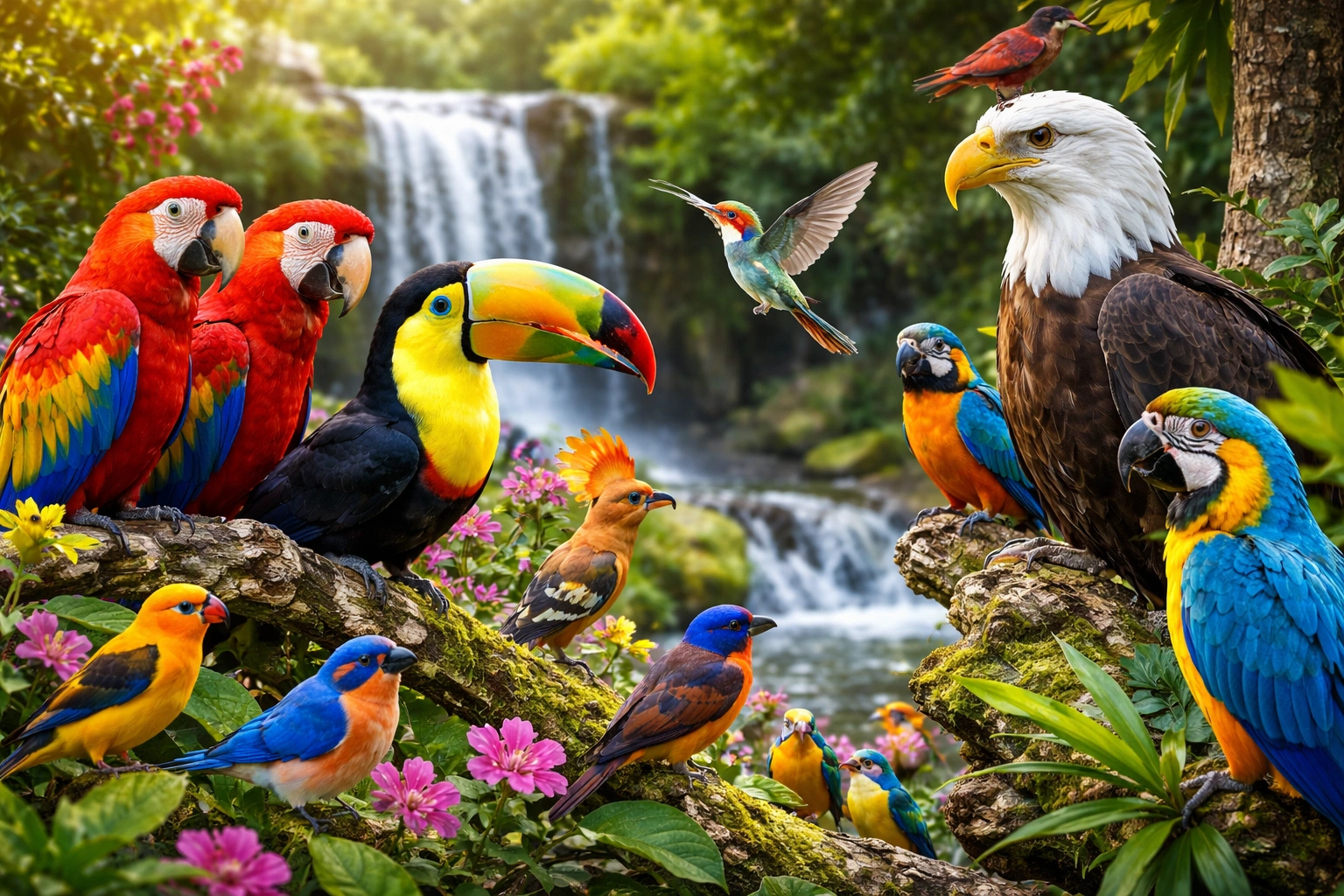
Explore Birds:
Content:
Have you ever looked up at the sky and wondered where all those beautiful birds are flying to? Birds are amazing creatures that come in every color of the rainbow!
Did you know that hummingbirds can flap their wings up to 80 times per second? Or that penguins are birds who love to swim instead of fly? Birds build incredible nests using twigs, leaves, and even spiderwebs!
What birds can you spot in your backyard? Look for sparrows, crows, and maybe even a bright red cardinal. Each bird has its own special song – it’s like they’re having a conversation with their friends!
🔍 Fun Activity: Next time you’re outside, close your eyes and listen. How many different bird songs can you count?
👉 Keep exploring: Want to meet more amazing animals? Check out our Discover Animals section or learn about Wild Animals from around the world!
Feathered Friends: A Colorful Journey into the World of Birds
Birds have fascinated humans for centuries, capturing our imagination with their vibrant colors, melodic songs, and astonishing diversity. From the tiny hummingbird, which hovers effortlessly in midair, to the majestic bald eagle soaring high above rugged landscapes, birds are among the most captivating creatures on Earth. Their significance stretches beyond mere beauty; birds play essential roles in ecosystems, culture, and even science, making them true feathered wonders of the natural world.
The Diversity of Birds
One of the most striking features of birds is their incredible diversity. There are over 10,000 known species worldwide, ranging from flightless birds like the ostrich to the agile aerialists like swifts and falcons. Birds have adapted to nearly every environment on the planet, from the icy expanses of Antarctica where penguins thrive, to dense tropical rainforests where toucans flaunt their rainbow-colored beaks.
Each species has evolved unique characteristics to survive and flourish. The arctic tern, for example, holds the record for the longest migration of any animal, traveling more than 70,000 kilometers annually between the Arctic and Antarctic. Meanwhile, owls have developed silent flight and exceptional night vision, allowing them to hunt under the cover of darkness. These adaptations are not only fascinating but also highlight the ingenuity of evolution in shaping creatures perfectly suited to their habitats.
Colors and Patterns: Nature’s Palette
Birds are renowned for their stunning plumage, which serves multiple purposes, from attracting mates to camouflaging from predators. The peacock’s iridescent tail feathers are one of the most iconic examples of how coloration can be used in courtship rituals, dazzling potential mates with their shimmering hues. In contrast, the cryptic coloring of many sparrows and nightjars helps them blend seamlessly into their surroundings, providing protection from predators.
Color in birds comes from two primary sources: pigments and structural coloration. Pigments, such as carotenoids, produce vivid reds, oranges, and yellows, often obtained from the bird’s diet. Structural coloration, on the other hand, arises from microscopic structures in feathers that refract light, creating brilliant blues, greens, and iridescent effects. This combination results in a breathtaking array of colors that has inspired artists, designers, and scientists alike.
Songs and Sounds: The Music of Birds
Beyond their visual splendor, birds are celebrated for their vocalizations. Birdsong serves many purposes: marking territory, signaling alarm, attracting mates, or communicating with flock members. Each species has its own repertoire, from the complex warbling of a nightingale to the rhythmic drumming of a woodpecker.
Birdsong is not only enchanting but also a subject of scientific interest. Ornithologists study bird vocalizations to understand communication, behavior, and even evolutionary relationships among species. Some birds, such as parrots and mynahs, can mimic human speech, demonstrating remarkable cognitive abilities and adaptability.
Birds and Ecosystems
Birds are integral to the health of ecosystems. They act as pollinators, seed dispersers, and pest controllers. Hummingbirds, for instance, transfer pollen as they feed on nectar, aiding in plant reproduction. Fruit-eating birds like hornbills help disperse seeds over vast distances, contributing to forest regeneration. Predatory birds, including hawks and owls, help maintain balance by controlling populations of rodents and insects.
Moreover, birds can serve as indicators of environmental health. Changes in bird populations often reflect changes in habitat quality, climate, and biodiversity. Conservationists monitor birds to track the effects of habitat loss, pollution, and climate change, making them vital allies in the fight to protect our natural world.
Cultural Significance
Throughout history, birds have held symbolic meanings in cultures worldwide. Doves often symbolize peace, while eagles represent strength and freedom. In mythology and folklore, birds are frequently seen as messengers between the earthly and spiritual realms. They inspire art, literature, and music, reminding us of the beauty, freedom, and fragility of life.
Conservation Challenges
Despite their beauty and importance, many bird species face threats from habitat destruction, pollution, climate change, and hunting. Conservation efforts, such as creating protected areas, restoring habitats, and implementing breeding programs, are essential to ensure that future generations can continue to marvel at these feathered friends. Birdwatching communities and citizen science projects also play a crucial role by raising awareness and collecting valuable data to support conservation.
A Personal Connection
Observing birds can be a deeply rewarding experience. Whether listening to the dawn chorus in a quiet forest, watching a robin forage in a backyard, or witnessing a flock of migratory geese cross the sky, birds offer moments of wonder and reflection. They remind us to slow down, appreciate nature, and consider our role in protecting the delicate balance of life on Earth.
Conclusion
Birds are more than just creatures of flight; they are symbols of nature’s creativity, resilience, and beauty. Their colors, songs, and behaviors provide endless fascination, while their ecological roles underscore their importance to the planet. By studying, appreciating, and conserving birds, we embark on a colorful journey into a world that is both mesmerizing and vital. From the tiniest hummingbird to the grandest eagle, feathered friends inspire awe, teaching us lessons about survival, adaptation, and the interconnectedness of life. In a world that often moves too quickly, birds invite us to pause, watch, and celebrate the beauty that soars above us every day.










Leave a Reply