

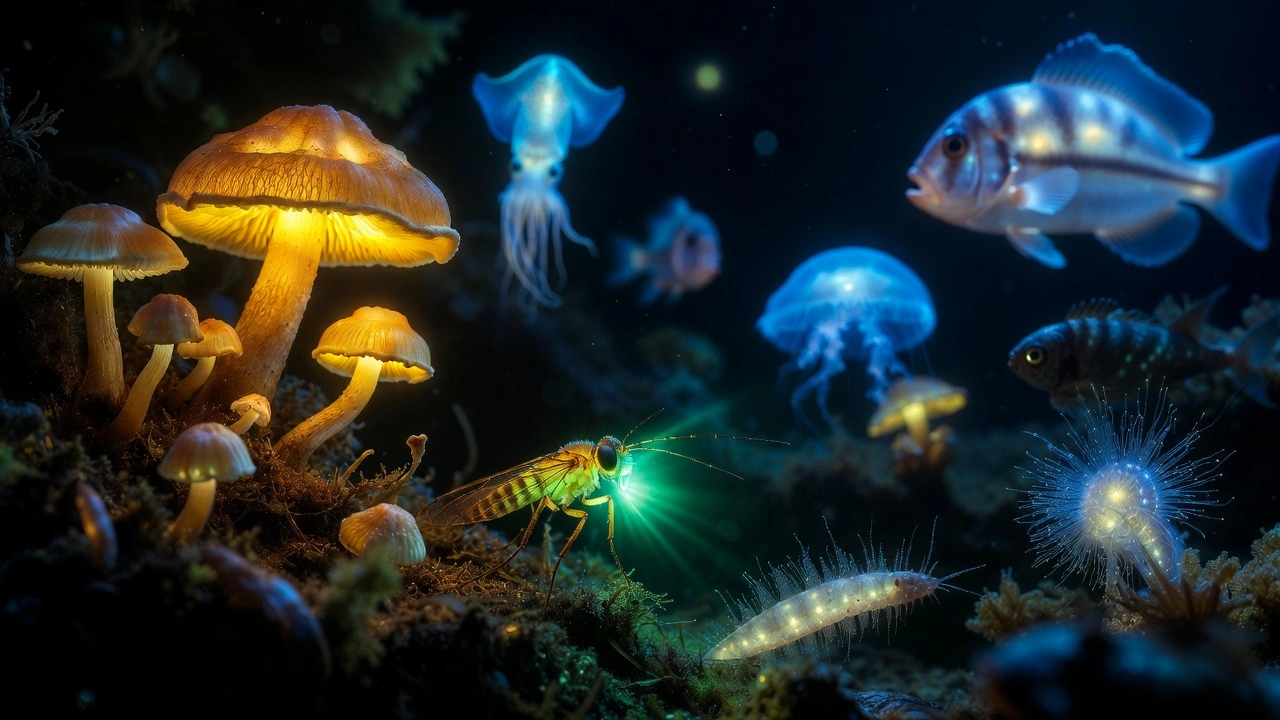
Imagine walking through a dense forest at midnight and spotting a faint, eerie green light pulsing from a fallen log. You move closer, and there, nestled among decaying wood, a mushroom glows like a fragment of the night sky fallen to earth. Or picture diving into the ocean’s depths, surrounded by darkness so complete it feels like space—until a wave of blue light erupts around you as fish scatter like living fireworks.
This isn’t fantasy. It’s not CGI. It’s real, and it’s happening all around us, every single day.
Bioluminescence—the ability of living organisms to produce and emit light—is one of nature’s most spectacular phenomena. And while it might feel like magic, the science behind it is perhaps even more wondrous.
The Chemistry of Living Light
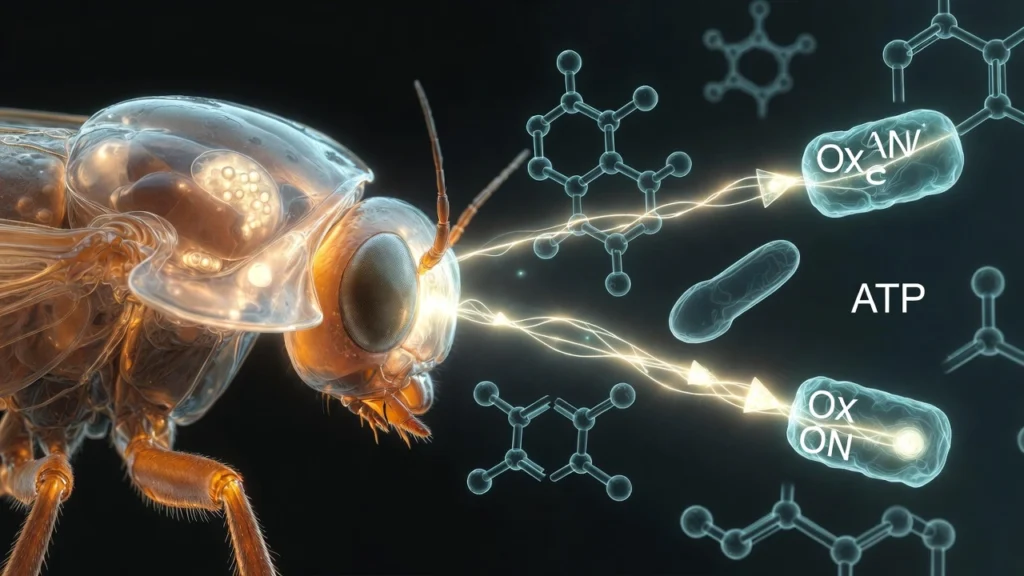
At its core, bioluminescence is a chemical reaction that happens inside a living organism. Think of it as nature’s version of a glow stick—but infinitely more elegant.
The magic happens when a molecule called luciferin (from the Latin lucifer, meaning “light-bringer”) reacts with oxygen. This reaction is accelerated by an enzyme called luciferase. When they meet, energy is released in the form of light.
But here’s where it gets fascinating: unlike the light bulb in your room, which wastes most of its energy as heat, bioluminescence is almost 100% efficient. Nearly all the energy produced becomes light. Your LED bulbs? They’re around 40% efficient. A firefly’s abdomen? 98%.
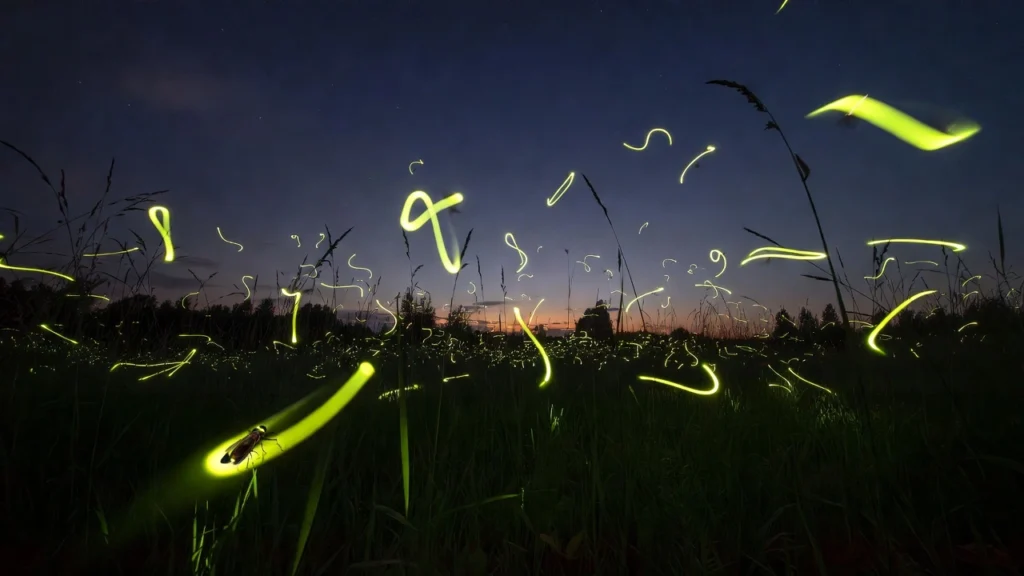
Different organisms use different types of luciferin, which is why we see such a variety of colors—from the green glow of fireflies to the blue sparkle of ocean plankton to the rare red light of certain deep-sea fish.
Why Glow? Nature’s Clever Reasons
Animals don’t produce light for our entertainment. They do it because it helps them survive. And the reasons are as diverse as the creatures themselves.
1. To Find Love in the Dark
Fireflies don’t just blink randomly. Their flashes are love songs written in light.
Each firefly species has its own unique flash pattern—a specific rhythm, duration, and color that acts like a secret handshake. Males fly through the night, broadcasting their species-specific code. Females, perched on vegetation below, watch for the right pattern. When they see a match, they flash back.
It’s a conversation conducted entirely in light, happening in backyards across America every summer evening.
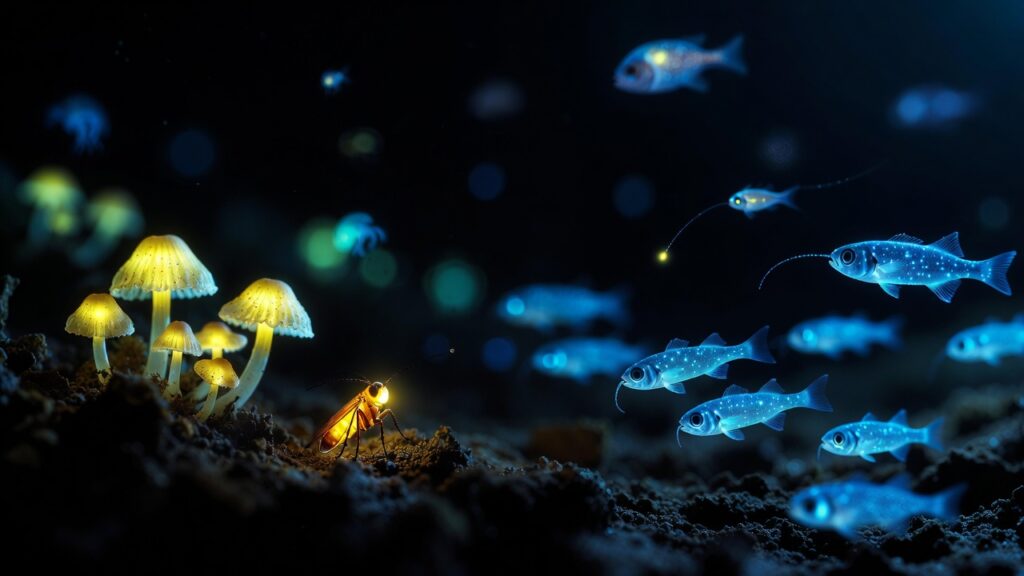
In the deep ocean, where sunlight never reaches, some anglerfish take a more direct approach. Females dangle a glowing lure in front of their toothy mouths. Smaller fish, curious about the light, swim closer—and become dinner. But the anglerfish’s own mate? He’s tiny, parasitic, and permanently fuses himself to her body, living off her nutrients in exchange for sperm when she’s ready to reproduce. Their entire relationship is built around her light.
2. To Confuse and Escape Predators
Imagine you’re a small fish swimming in the open ocean. You’re exposed. Vulnerable. Any predator below can see your silhouette against the faint light filtering from above.
But what if you could erase that silhouette?
Many deep-sea fish and squid have light-producing organs on their undersides that generate just enough light to match the downwelling sunlight. From below, they virtually disappear—a trick called counter-illumination. It’s nature’s invisibility cloak.
Other creatures use light as a smokescreen. When threatened, some shrimp and squid release a cloud of glowing mucus or fluid into the water. The predator is momentarily blinded, confused, or distracted by the sudden burst of light—and their intended meal escapes into the darkness.
3. To Lure Prey to Their Death
The anglerfish is the classic example, but far from the only one.
Some jellyfish have sticky, glowing tentacles that act as both lure and trap. Small creatures attracted to the light become entangled and consumed.
Deep-sea dragonfish produce red light—invisible to most other deep-sea creatures, which can only see blue. They can illuminate their prey like a sniper with night vision, hunting in plain sight while their victims remain unaware.
4. To Warn Predators: “I’m Dangerous”
You’ve probably seen the logic of warning colors before—bright red or yellow patterns that scream “don’t eat me, I’m toxic.” Bioluminescence can serve the same purpose.
Some marine worms and small squid are bioluminescent and distasteful. When attacked, they light up. Predators quickly learn to associate that glow with a terrible taste. The light becomes a warning sign: “I’m not worth it.”
This works for the predator, too. One bad experience with a glowing meal, and they’ll avoid anything that lights up in the future.
5. To Recruit Bodyguards
This might be the cleverest use of bioluminescence of all.
Some species of small squid and fish are bioluminescent, but they don’t produce the light themselves. Instead, they host luminous bacteria in specialized light organs. The bacteria get a safe home and nutrients. The host gets light it can use for camouflage or communication.
It’s a perfect partnership—and it works so well that some species have evolved complex lenses, shutters, and color filters to control their bacterial light with surgical precision, as if operating a tiny submarine’s spotlight.
Where to Find Living Light
Bioluminescence is far more common than most people realize.
In the ocean, it’s nearly everywhere. In fact, in the deep sea—below 200 meters where sunlight can’t reach—up to 90% of animals are bioluminescent. From glowing jellyfish and comb jellies to flashlight fish with built-in headlamps, the deep ocean is a continuous light show we rarely see.
On land, it’s rarer but still present. Fireflies are the most familiar example, but there are also glowing click beetles, railroad worms (whose name doesn’t do justice to their spectacular red-and-green light displays), and even glowworms—the larvae of certain gnats and flies—that dangle glowing silk threads from cave ceilings to trap unsuspecting prey.
In the forest, you might find bioluminescent fungi. Over 100 species of mushrooms glow, typically with a faint green light. Scientists aren’t entirely sure why—perhaps to attract insects that will help spread their spores, or simply as an unavoidable byproduct of their metabolism.
The Human Connection
For thousands of years, humans have been fascinated by bioluminescence. Ancient mariners wrote of “burning seas” where waves glowed like fire. Indigenous peoples collected glowing fungi and insects for decoration and ceremony. Aristotle puzzled over the “cold fire” of decaying fish and meat.
Today, we’re putting bioluminescence to work.
Medical research uses bioluminescent genes from jellyfish and fireflies as biological markers. Scientists can insert these genes into cells or organisms to track cancer progression, monitor infections, or see when genes are activated. It’s like having a living, breathing light-up map of biological processes.
Environmental monitoring uses bioluminescent bacteria that glow less brightly when exposed to toxins. It’s a quick, natural way to test water safety.
Art and design are exploring bioluminescence too. Artists have created glowing plants (by inserting firefly genes), and designers dream of streets lit by bioluminescent trees instead of electric lamps.
And then there’s the sheer wonder of it. Every summer evening, children chase fireflies across American lawns. Every night, in oceans worldwide, unseen creatures flash and sparkle in the darkness. It’s a reminder that magic doesn’t require spells or wizards—it requires only that we pay attention.
The Deeper Magic
There’s something humbling about bioluminescence.
We humans have spent centuries perfecting our ability to make light. We’ve gone from candles to gas lamps to incandescent bulbs to LEDs, each step more efficient than the last. And yet, we still can’t match what a firefly does in a meadow or what a jellyfish does in the sea.
Nature achieved 98% efficiency billions of years before we ever struck a match. It created light without heat, communication without sound, camouflage without cloth, and warning signals without paint. It did all this using nothing more than chemistry, evolution, and time.
That’s not magic in the supernatural sense. But it is magical in the truest sense of the word—full of wonder, mystery, and the kind of beauty that stops you in your tracks and reminds you that you’re alive on an astonishing planet.
So the next time you see a firefly blink in your backyard, or watch a documentary about glowing deep-sea creatures, or read about scientists using bioluminescence to fight cancer, remember:
You’re not just seeing light. You’re seeing 500 million years of evolution. You’re seeing survival strategies refined to perfection. You’re seeing chemistry so elegant it makes our best technology look clunky.
You’re seeing the world as it really is—a place far stranger, far more beautiful, and far more magical than we usually give it credit for.
And that’s worth stopping to appreciate.
FAQs:
1️⃣ Why do some animals glow in the dark?
Some animals glow in the dark because of a natural chemical reaction called bioluminescence. Inside their bodies, a molecule called luciferin reacts with oxygen, often with the help of an enzyme called luciferase, producing light instead of heat.
This process is highly energy-efficient and is commonly found in deep-sea creatures like jellyfish, squid, and certain fish. The glow can help them attract prey, communicate, or avoid predators.
2️⃣ Is glowing in the dark the same as fluorescence?
No. Bioluminescence and fluorescence are different.
- Bioluminescence: The animal produces its own light through a chemical reaction.
- Fluorescence: The animal absorbs external light (like blue or UV light) and re-emits it in a different color.
For example, many jellyfish produce bioluminescent light, while some frogs and corals appear fluorescent under specific lighting conditions.
3️⃣ What is the purpose of bioluminescence in animals?
Bioluminescence serves several survival functions:
- Attracting prey (like anglerfish using glowing lures)
- Camouflage (counter-illumination in deep-sea fish)
- Defense (startling predators or releasing glowing ink)
- Communication and mating signals
In deep ocean environments where sunlight does not reach, glowing light becomes a critical evolutionary adaptation.



Leave a Reply