

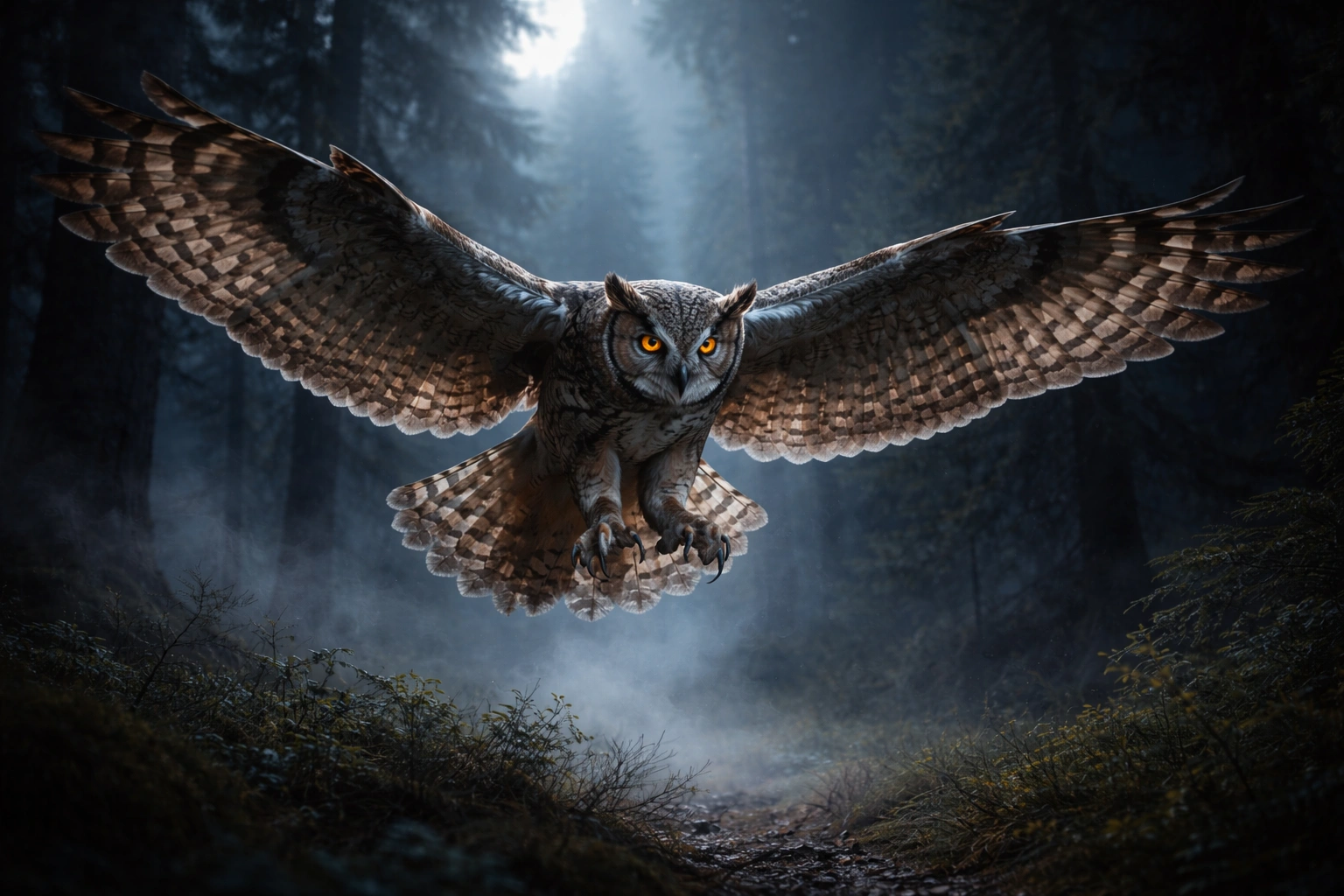
When the sun sets and most birds retreat to their roosts, another world awakens. In the darkness, a silent hunter takes to the skies—wings muffled, eyes blazing, ears tuned to the faintest rustle of a mouse in the grass below. This is the owl, nature’s most sophisticated nocturnal predator.
Owls have fascinated humans for thousands of years. They appear in cave paintings, Egyptian hieroglyphs, Greek mythology, and Indigenous folklore around the world. We’ve associated them with wisdom, with death, with magic—but the reality of these remarkable birds is even more extraordinary than the myths.
From feathers designed for absolute silence to ears that function like satellite dishes and eyes that see in near-total darkness, owls are evolution’s masterpiece of night hunting. This is the story of how they do it—and why they’ve become the stuff of legend.
The Silent Flight: Nature’s Stealth Technology
If you’ve ever heard an owl fly, you haven’t. That’s the point.
Most birds make noise when they fly—the whoosh of wings, the rustle of feathers, the subtle sound of air rushing past wing surfaces. For a nocturnal hunter, this presents a problem: prey hears you coming and escapes long before you strike.
Owls have solved this problem with extraordinary precision.
The Feather Engineering
An owl’s flight feathers are unlike those of any other bird:
Serrated leading edges: The front edge of an owl’s primary feathers has a comb-like structure of tiny, stiff projections called “fimbriae” or “flutings.” These serrations break up the air turbulence that normally creates whooshing sounds, turning large vortices into tiny, silent micro-turbulences .
Soft, velvety surfaces: The upper surfaces of owl feathers are covered in a soft, downy pile that absorbs sound. Think of it like felt covering a speaker—it dampens vibrations before they can become noise.
Fringed trailing edges: The back edges of owl feathers have soft, flexible fringes that further break up turbulence and eliminate the last traces of sound.
Flexible vanes: The individual barbs of owl feathers are unusually flexible, allowing them to bend and absorb energy rather than transmitting it as sound.
Together, these adaptations make owl flight virtually silent. A great horned owl can fly within inches of a mouse without the mouse ever hearing it coming.
The Cost of Silence
This silence comes at a cost. The same adaptations that muffle sound also reduce flight efficiency—owls can’t fly as fast or as far as hawks or eagles. But for an ambush predator that relies on surprise, the tradeoff is worth it.
Scientists are now studying owl feathers to design quieter wind turbines, fans, and aircraft. Nature’s stealth technology may soon find its way into human engineering.
The Eyes: Seeing in the Dark
An owl’s eyes are its most striking feature—large, forward-facing, and seemingly glowing with intelligence. But their appearance is just the beginning.
Size Matters
Owl eyes are enormous relative to their body size. If human eyes were proportionally as large, they’d be the size of grapefruits . This size allows owls to gather as much light as possible in dim conditions.
Light-gathering ability: An owl’s eyes are about 100 times more sensitive to light than human eyes . They can see in light levels so low that humans would perceive only blackness.
Tube-Shaped Eyes
Unlike human eyes, which are roughly spherical, owl eyes are elongated tubes. This shape provides several advantages:
- Longer focal length: Like a telephoto lens, tube-shaped eyes magnify images, giving owls better detail vision at a distance.
- Larger retina: More surface area for light-sensitive cells (rods and cones).
- Denser rod packing: Owls have an extraordinary density of rods—the cells responsible for low-light vision. Some species have up to 1 million rods per square millimeter of retina .
The Tradeoff: Fixed Eyes
The tube shape has one major drawback: owl eyes can’t move in their sockets. While human eyes can swivel to follow movement, an owl’s eyes are essentially locked in place.
To compensate, owls have evolved extremely flexible necks. They can rotate their heads up to 270 degrees—more than three-quarters of a full circle—without moving their bodies . Special adaptations in their blood vessels and vertebrae prevent them from cutting off blood flow during extreme rotation.
Binocular Vision
Like other predators, owls have forward-facing eyes that provide binocular vision—overlapping fields of view that enable depth perception. This is essential for judging distance during a strike. The overlap in owl vision is about 50–70%, compared to 140° in humans .
The Nictitating Membrane
Owls have a third eyelid—the nictitating membrane—that sweeps horizontally across the eye to clean, moisten, and protect it. You’ll often see owls blink with this membrane during feeding or flight, keeping their precious eyes in peak condition.
Do Owls See in Color?
For decades, scientists believed owls were colorblind. We now know this isn’t quite true. Owls have both rods and cones in their retinas, so they can perceive some color. However, their color vision is limited compared to diurnal birds—they see best in the blue-green spectrum and likely have reduced red sensitivity .
The Ears: Hearing Beyond Human Limits
As remarkable as owl eyes are, their ears may be even more impressive. For many owl species, hearing is the primary sense for locating prey—especially in complete darkness or under snow.
Asymmetrical Ears
Here’s one of the strangest adaptations in the animal kingdom: many owl species have asymmetrical ears—one ear higher on the head than the other .
In the great gray owl, the left ear opening is higher than the right. In the barn owl, the left ear is higher and points slightly downward, while the right ear points slightly upward. These asymmetries are subtle—often hidden by feathers—but they’re crucial for hunting.
How it works: When a sound reaches the owl, it arrives at the two ears at slightly different times and intensities. The owl’s brain analyzes these minute differences to pinpoint the exact location of the sound source in both horizontal and vertical dimensions .
A barn owl can locate a mouse in complete darkness solely by sound, striking with pinpoint accuracy even when it can’t see its prey.
The Facial Disk
Look at an owl’s face, and you’ll notice a distinctive dish-like shape formed by specialized feathers. This isn’t just for looks—it’s a sophisticated sound-collecting device.
The facial disk acts like a satellite dish, funneling sound waves toward the ear openings. The feathers around the disk are stiff and movable; owls can adjust them to fine-tune sound collection. Some species can even change the shape of their facial disk to focus on different frequencies.
Frequency Range
Owls hear best at frequencies between 3,000 and 9,000 Hz—the range where small mammals make rustling sounds . They can detect sounds as faint as 0.02 decibels, far below human hearing threshold .
Hunting by Sound Alone
The barn owl’s ability to hunt by sound is so precise that it can strike a mouse in total darkness based on auditory cues alone. In laboratory experiments, barn owls successfully captured prey using only hearing—even when the sound source was hidden under leaves or snow .
The Talons: Weapons of Precision
Once an owl locates its prey, the talons deliver the killing blow. Owl talons are formidable weapons, adapted for quick, silent kills.
Specialized Structure
- Four toes: Owls have four toes per foot, arranged in a zygodactyl pattern—two forward, two backward. This gives them an exceptionally strong grip.
- Opposable outer toe: Many owls can rotate their outer toe forward or backward, depending on the situation.
- Sharp, curved claws: Owl talons are razor-sharp and strongly curved, designed to penetrate prey and hold tight.
- Feathered legs: In many species, feathers extend down the legs and even onto the toes, providing insulation and further muffling sound during the strike.
Grip Strength
An owl’s grip is astonishingly powerful. A great horned owl can exert 500–600 pounds per square inch of pressure with its talons—enough to crush the spine of prey much larger than itself .
The Strike
When an owl strikes, it swings its feet forward just before impact, using the momentum of its flight to drive talons deep into prey. The impact itself can kill small prey; larger prey are dispatched with a quick bite to the neck.
Unlike hawks, which often kill by repeated talon punctures, owls typically kill with a single, precisely placed bite that severs the spinal cord. This quick kill minimizes struggle and noise—important for a predator that may need to hunt again soon.
Digestion: The Pellet Phenomenon
One of the most distinctive features of owl biology is the production of pellets. After eating, owls regurgitate compact masses of indigestible material—bones, fur, feathers, teeth—that they swallowed along with their prey.
Why Pellets?
Owls, like many birds, don’t have teeth to chew their food. They swallow prey whole or in large chunks. The digestive system extracts nutrients from soft tissues, but hard materials like bones and fur can’t be digested.
Instead of passing these materials through the entire digestive tract (which would be inefficient and potentially dangerous), the owl’s stomach compacts them into a pellet and regurgitates it 6–10 hours after eating .
What Pellets Reveal
Owl pellets are treasure troves for scientists—and for curious kids. By dissecting pellets, researchers can determine exactly what owls ate, revealing:
- Prey species present in the area
- Relative abundance of different prey
- Seasonal changes in diet
- Health of local small mammal populations
In classrooms across the world, owl pellet dissection is a beloved activity that teaches students about food chains, anatomy, and scientific inquiry.
Pellet Frequency
An owl typically produces 1–2 pellets per day, depending on how much it eats. After producing a pellet, the owl may resume hunting—it’s essentially reset its digestive system for another meal.
Owl Species: A Diversity of Hunters
With over 200 species worldwide, owls occupy nearly every habitat on Earth except Antarctica. Let’s meet some of the most remarkable:
Great Horned Owl (Bubo virginianus)
The great horned owl is the most widespread and adaptable owl in the Americas, found from Alaska to Argentina. It’s a powerful predator capable of taking prey as large as skunks, rabbits, and even other raptors.
Size: 18–25 inches, 2–4 pounds
Wingspan: 3–5 feet
Distinctive feature: Prominent ear tufts (not actually ears—just feathers)
Hunting style: Generalist; takes whatever prey is available
Barn Owl (Tyto alba)
The barn owl is the most widespread land bird species, found on every continent except Antarctica. It’s the owl most associated with human structures—barns, churches, abandoned buildings—hence its name.
Size: 12–16 inches, 1 pound
Wingspan: 3–4 feet
Distinctive feature: Heart-shaped facial disk; ghostly white underside
Hunting style: Open-country hunter specializing in rodents; exceptional hearing
Great Gray Owl (Strix nebulosa)
The great gray owl is the tallest owl in North America, though its fluffy feathers make it look even larger than it is. It’s adapted for hunting in cold northern forests and meadows.
Size: 24–33 inches, 2–3 pounds
Wingspan: 4–5 feet
Distinctive feature: Massive facial disk; yellow eyes; “bow tie” of white feathers
Hunting style: Hovers over snow, listening for rodents moving underneath
Snowy Owl (Bubo scandiacus)
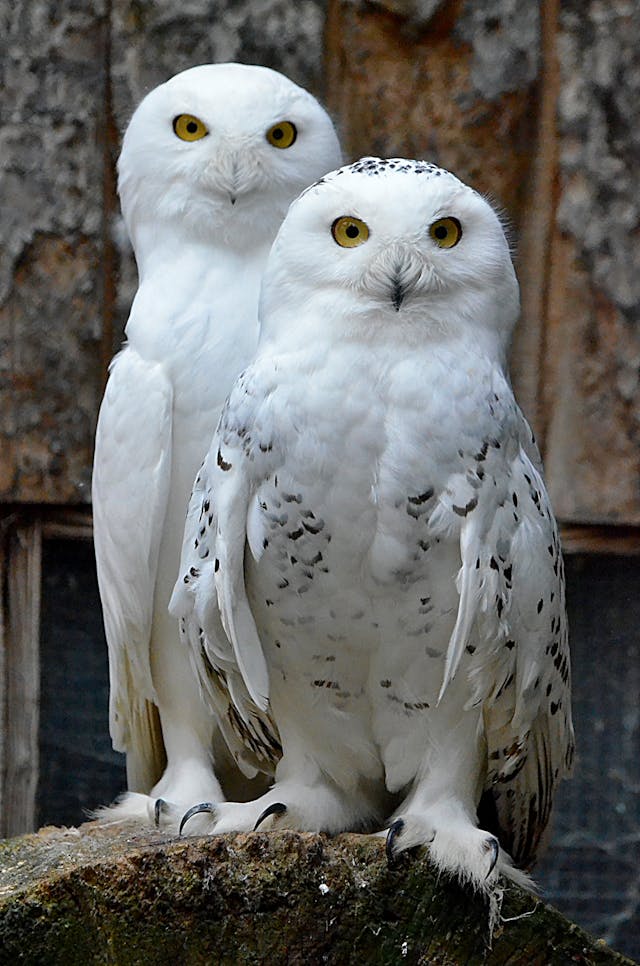
The snowy owl is the only owl with predominantly white plumage—a perfect adaptation for its Arctic habitat. Made famous by the Harry Potter series, these owls are powerful hunters of lemmings, ptarmigan, and Arctic hares.
Size: 20–28 inches, 3–6 pounds (females larger than males)
Wingspan: 4–5 feet
Distinctive feature: Pure white plumage (males) with variable dark spotting (females)
Hunting style: Perch-and-scan hunter in open tundra; irruptive migrates south when food is scarce
Elf Owl (Micrathene whitneyi)
The elf owl is the smallest owl in the world, tiny enough to fit in the palm of your hand. It lives in the southwestern U.S. and Mexico, nesting in woodpecker holes in saguaro cacti.
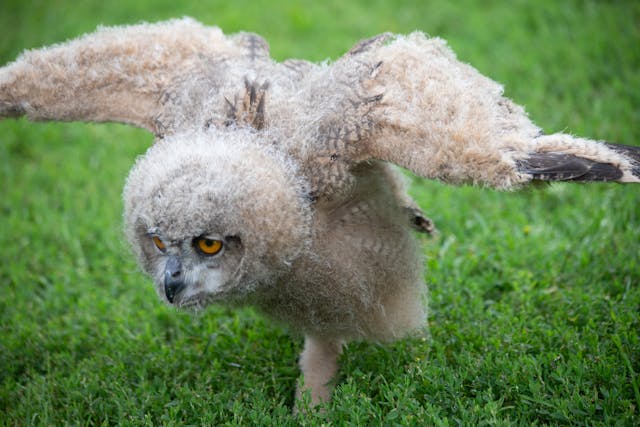
Size: 5–6 inches, 1–2 ounces
Wingspan: 10–12 inches
Distinctive feature: Tiny size; no ear tufts; short tail
Hunting style: Insect specialist; hawks moths and beetles in flight
Northern Hawk Owl (Surnia ulula)
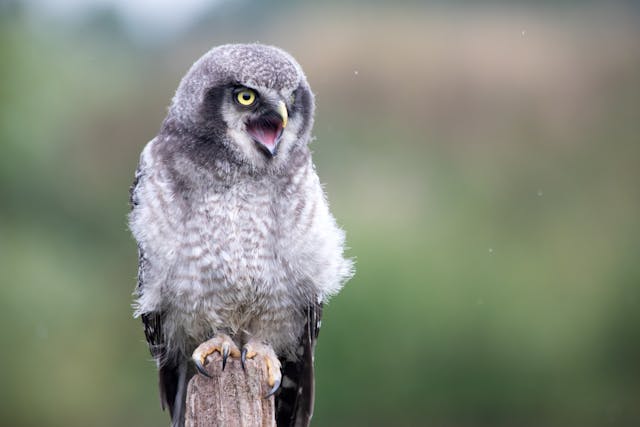
The northern hawk owl looks and behaves like a hawk—hence its name. It’s active during the day, perches prominently like a hawk, and hunts by sight rather than sound.
Size: 14–17 inches, 10–12 ounces
Wingspan: 2–3 feet
Distinctive feature: Long tail; hawk-like shape; diurnal habits
Hunting style: Perch-hunts for voles and small birds; active during daylight
Burrowing Owl (Athene cunicularia)
The burrowing owl is one of the most unusual owls—it lives underground. Found in open grasslands of the Americas, these owls nest in burrows dug by prairie dogs, ground squirrels, and other animals.
Size: 7–10 inches, 5–8 ounces
Wingspan: 20–24 inches
Distinctive feature: Long legs; short tail; lives in burrows
Hunting style: Runs after insects and small prey on the ground; active day and night
Owl Calls: The Voices of the Night
Owls are vocal creatures, and their calls are among the most recognizable sounds in nature. Each species has a distinctive repertoire:
Great horned owl: The classic “hoo-hoo-hooo” of movies and folklore—a deep, resonant series of 4–5 hoots.
Barn owl: Not a hoot but a long, eerie shriek—the source of many “ghost” stories around old buildings.
Eastern screech-owl: A descending whinny or a soft, mournful trill—nothing like a screech despite the name.
Barred owl: The “who-cooks-for-you” owl, with a distinctive eight-hoot call that sounds like it’s asking a question.
Northern saw-whet owl: A series of soft, rhythmic toots—like a saw being sharpened, hence the name.
Great gray owl: Deep, resonant hoots arranged in a slow series.
Owls call to establish territories, attract mates, and communicate with family members. During breeding season, forests and fields come alive with their voices.
Owl Behavior: Daily Life of a Nocturnal Hunter
Roosting
During the day, owls roost—rest in concealed spots. They choose locations that provide camouflage and protection: dense foliage, tree cavities, rock crevices, or abandoned buildings. Many owls roost alone, but some species (like long-eared owls) roost communally in winter.
When resting, owls often adopt a distinctive posture: body upright, feathers fluffed for insulation, eyes closed or partially closed. Some species compress their feathers to look like part of the tree—a camouflage tactic called “concealment posture.”
Territory
Owls are territorial, especially during breeding season. Males establish and defend territories through calling and, if necessary, physical confrontation. Territory size varies enormously by species and habitat—from a few acres for small owls to several square miles for large species.
Migration
Most owls are resident—they stay in one area year-round. However, some species migrate:
- Northern saw-whet owls: Regular migrants, with thousands passing through banding stations each fall
- Snowy owls: Irruptive migrants—they move south in years when lemming populations crash in the Arctic
- Short-eared owls: Partial migrants, moving to avoid harsh winters
Breeding
Owl breeding seasons vary by species and location. In temperate regions, most owls breed in late winter or early spring, timing chick-rearing to coincide with peak prey availability.
Courtship: Males attract females through calling, display flights, and food offerings. In some species, males perform elaborate aerial displays.
Nesting: Owls use a variety of nest sites. Some build their own nests (rare), but most use existing structures:
- Tree cavities
- Old hawk or squirrel nests
- Cliff ledges
- Burrows (burrowing owls)
- Human structures (barn owls)
Eggs: Clutch size varies from 1–2 (large eagles) to 10–12 (some small owls in peak lemming years). Eggs are laid at intervals, so chicks hatch at different times—creating a size hierarchy.
Incubation: Females do most incubation while males bring food. Incubation lasts 25–35 days depending on species.
Chick development: Owl chicks (owlets) are born covered in white down, eyes closed. They develop rapidly, fledging at 4–10 weeks depending on species. Parents continue feeding fledglings for weeks or months until they learn to hunt independently.
Longevity
Owls can live surprisingly long lives:
- Small owls: 3–10 years in wild, up to 15 in captivity
- Large owls: 10–20 years in wild, up to 30+ in captivity
- Record: A great horned owl lived 38 years in captivity
Owl Intelligence
Owls are often associated with wisdom, but how smart are they really?
The answer is nuanced. Owls aren’t as “intelligent” as crows or parrots in terms of problem-solving and tool use. Their brains are specialized for different tasks—processing sensory information, coordinating precise strikes, remembering good hunting spots and territory boundaries.
What owls excel at:
- Spatial memory: Remembering thousands of potential perches and hunting spots
- Sensory processing: Extraordinary ability to integrate visual and auditory information
- Hunting strategy: Learning which hunting techniques work best in different conditions
What owls struggle with:
- Novel problem-solving: They’re less flexible than crows when faced with new challenges
- Tool use: No owl has been documented using tools in the wild
- Social learning: Limited compared to highly social species
So owls aren’t “wise” in the human sense—but they’re perfectly adapted for their lifestyle. In the niche they occupy, they’re geniuses.
Owls and Humans
Cultural Significance
Owls have fascinated humans for millennia, appearing in cultures worldwide:
- Ancient Greece: The little owl was associated with Athena, goddess of wisdom—hence the connection.
- Rome: Owl calls were omens of death; hearing an owl hoot meant someone would die.
- Indigenous North America: Various tribes viewed owls differently—some as messengers, some as healers, some as witches.
- Hinduism: The owl is associated with Lakshmi, goddess of wealth.
- Medieval Europe: Owls were associated with witchcraft and evil—perhaps because of their nocturnal habits and eerie calls.
- Modern times: Owls are beloved symbols of conservation, appearing in books (Winnie-the-Pooh, Harry Potter), movies, and merchandise.
Threats
Despite their cultural significance, many owl species face serious threats:
Habitat loss: Logging, agriculture, and development destroy nesting and hunting habitat. Old-growth forests are especially important for cavity-nesting species.
Rodenticides: Poison used to kill rats and mice accumulates in owls that eat poisoned prey, causing secondary poisoning. A 2024 study found rodenticides in 80% of tested owls .
Vehicle collisions: Owls hunting along roads are frequently hit by cars.
Power lines: Electrocution and collision with power lines kill thousands of owls annually.
Climate change: Alters prey availability and habitat suitability. Snowy owls, adapted to Arctic conditions, face an uncertain future as the Arctic warms.
Persecution: Despite protections, owls are still shot, trapped, and poisoned by people who view them as threats to poultry or game.
Conservation Successes
There are bright spots:
- Barn owl nest box programs: Farmers worldwide install nest boxes to attract barn owls for natural rodent control, reducing need for poison.
- Habitat protection: National parks, wildlife refuges, and private preserves protect critical owl habitat.
- Rehabilitation: Wildlife rehabilitation centers treat injured owls and release them when possible.
- Public education: Growing appreciation for owls reduces persecution and increases support for conservation.
How to Help Owls
If you want to help owls:
- Install a nest box: Many owls readily use nest boxes. Check with local wildlife agencies for species-specific designs.
- Avoid rodenticides: Use snap traps or other non-poison methods for rodent control.
- Drive carefully at dusk and dawn: Owls are most active then and often hunt along roads.
- Support conservation organizations: Groups like The Owl Research Institute, The Raptor Trust, and local wildlife rehab centers do vital work.
- Keep cats indoors: Outdoor cats kill millions of birds annually, including young owls.
- Preserve habitat: Leave dead trees standing if safe—they provide nest cavities.
Owl Watching: How to Observe Responsibly
Owls are challenging to observe—they’re nocturnal, secretive, and easily disturbed. If you’re lucky enough to find one:
- Keep your distance: Use binoculars or a spotting scope. Getting too close can flush the owl, wasting precious energy.
- Be quiet: Whisper if you must talk. Sudden noises startle owls.
- Don’t use flash photography: It can temporarily blind and disorient them.
- Don’t play calls: Playing recorded owl calls during breeding season can disrupt territorial behavior and cause owls to waste energy responding to a non-existent rival.
- Leave if the owl shows stress: Signs include flattened feathers, repeated head-turning, or flying away. You’re too close.
- Respect roost sites: Owls need to rest during the day. Repeated disturbance can force them to abandon good roosting spots.
Best Places to See Owls
- Wildlife refuges: Many national wildlife refuges have good owl populations.
- Grasslands and meadows: Short-eared owls hunt over open areas at dusk.
- Forest edges: Great horned and barred owls hunt along forest edges.
- Barns and old buildings: Barn owls often roost in structures.
- Your own backyard: If you have trees and open space, you might host an owl without knowing it. Listen at night!
The Future of Owls
Owls face an uncertain future, but there’s reason for hope. Public appreciation for these remarkable birds has never been higher. Conservation efforts are growing. And owls themselves are resilient—they’ve survived millions of years of change.
The key is habitat protection. Owls need space to hunt, places to nest, and healthy prey populations. As long as we preserve these essentials, owls will continue to grace our nights with their silent flight and haunting calls.
The next time you hear an owl hoot in the darkness, pause and listen. You’re hearing one of nature’s most extraordinary creations—a whisper in the dark, perfected over millions of years, still hunting as it always has.
Key Takeaways
- Owls have evolved silent flight through specialized feathers with serrated leading edges, soft surfaces, and fringed trailing edges—adaptations that eliminate the sound of air rushing over wings .
- Owl eyes are tube-shaped and fixed in their sockets, forcing them to rotate their heads up to 270 degrees to track movement .
- Owls have extraordinary low-light vision, with eyes 100 times more sensitive to light than human eyes .
- Many owls have asymmetrical ears, allowing them to pinpoint prey location in both horizontal and vertical dimensions using minute differences in sound arrival time .
- The facial disk acts as a satellite dish, funneling sound toward ear openings .
- Owl talons can exert 500–600 pounds per square inch of pressure—enough to crush prey spines instantly .
- Owls produce pellets of indigestible material (bones, fur, feathers) that scientists study to understand diet and ecosystem health .
- Over 200 owl species exist worldwide, occupying every continent except Antarctica, from Arctic tundra to tropical rainforest .
- Owls face serious threats including habitat loss, rodenticide poisoning, vehicle collisions, and climate change .
- Conservation efforts like nest box programs and habitat protection are helping, but much work remains .





Leave a Reply