

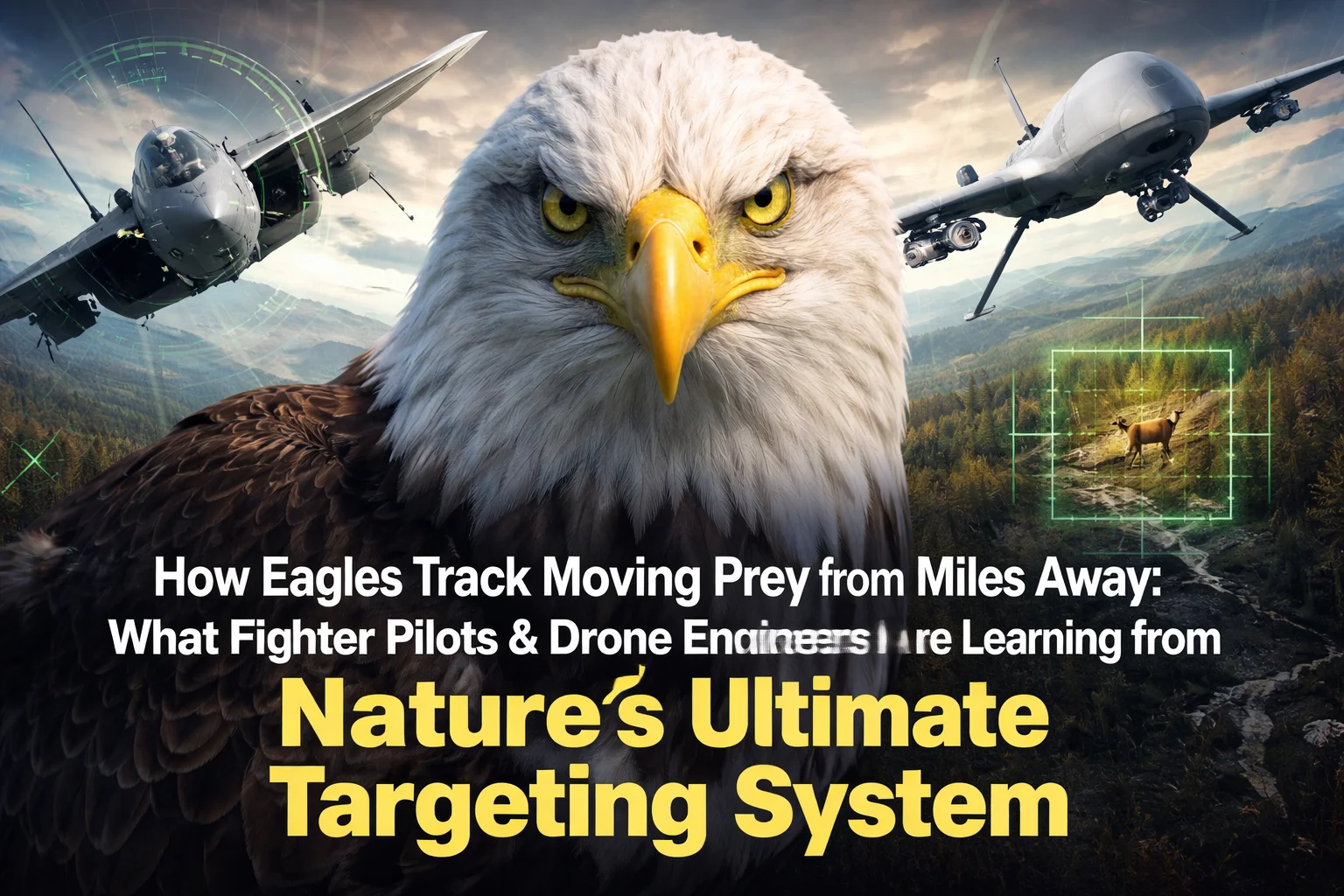
How Eagles Track Moving Prey at Extreme Distances
What Fighter Pilots and Drone Engineers Are Learning from a Bird
I watched a golden eagle lock onto a rabbit from over a mile away. The rabbit was moving. The eagle was moving. Wind was gusting at 25 knots. And yet, in seconds, that bird executed a perfect intercept that would make any missile guidance engineer jealous.
As someone who works at the intersection of tracking systems and wildlife biology, I’ve spent years asking a simple question: How do they do it? The answer isn’t just interesting—it’s shaping how we build autonomous drones, missile guidance systems, and even search-and-rescue aircraft.
Let me walk you through what’s actually happening inside that eagle’s head, from a practical engineering perspective.
The Sensor Problem: Seeing Detail at a Mile
Here’s a test. Stand in a parking lot. Find someone a thousand feet away—about three football fields. Can you tell if they’re holding a phone? Probably not.
An eagle, at that same distance, could tell you which finger they’re using to scroll.
The reason comes down to what engineers call angular resolution—the smallest angle between two points that your sensor can distinguish. Human vision maxes out around 60 cycles per degree. An eagle’s retina hits 140 cycles per degree. That’s not twice as good. It’s four times better in linear terms, which translates to sixteen times the resolving area.
Practical takeaway for engineers: The eagle’s fovea achieves near-theoretical limits for its optical aperture. Most man-made EO/IR tracking systems operate at 50-70% of their theoretical limit. The eagle operates at 90%+. The lesson? Sensor optimization matters more than raw sensor size.
But here’s what’s even more interesting. Eagles don’t just have high-resolution vision—they deploy it surgically.
The Tracking Strategy: Why Eagles Don’t Stare
If you watch an eagle hunting, you’ll notice something odd. Its head moves. Constantly. Quick, sharp movements called saccades.
This puzzled early researchers. Why wouldn’t the eagle just lock its gaze on the target and hold steady?
The answer reveals something profound about tracking: staring creates blind spots.
When you fixate on a single point, your visual system adapts. Receptors fatigue. Motion stops registering. The eagle’s solution? Sample, update, sample again. Each saccade is a fresh frame, a new data point.
Researchers comparing eagles to tawny frogmouths (ambush predators that freeze and wait) found eagles make saccades ten times more frequently. The eagle isn’t watching. It’s sampling.
Practical takeaway for engineers: This is identical to the trade-off in phased array radar systems. Do you dwell on a track for high confidence, or scan rapidly to maintain situational awareness? Eagles solved this problem by doing both—using the high-resolution fovea for target detail during saccade dwells, and lower-resolution peripheral vision for wide-area search.
The Flapping Signature: Nature’s Micro-Doppler
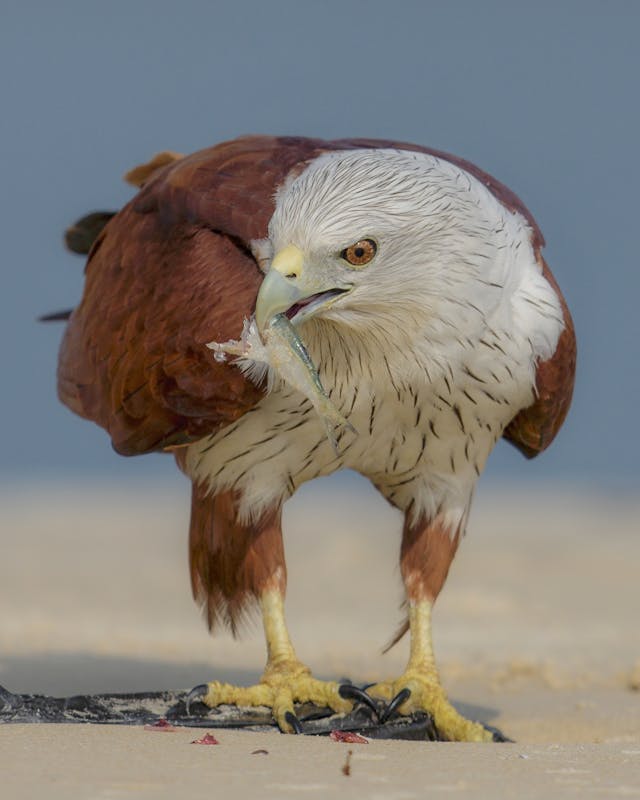
I once watched a peregrine falcon target a pigeon in flight. The falcon didn’t just see the pigeon—it identified it as a pigeon by the way it moved.
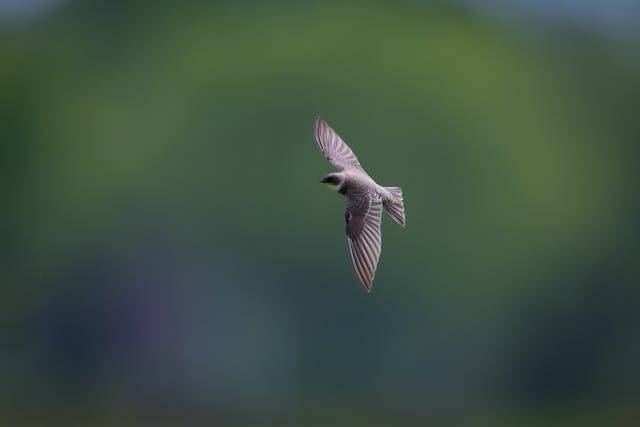
We now know that eagles, falcons, and hawks can distinguish prey species by their flapping signature. Each bird species has a characteristic wingbeat frequency and pattern. To the eagle’s visual system, a duck doesn’t just look different—it moves differently.
This is functionally identical to what radar engineers call micro-Doppler analysis. When a bird flies, its wings create periodic modulations in the reflected signal. Modern radar systems use Short-Time Fourier Transforms (STFT) to extract these signatures from noise. The eagle does the same thing with its neural processing—integrating visual signals over time to enhance periodic patterns while suppressing irrelevant motion.
Practical takeaway for engineers: The eagle’s approach to target discrimination is temporal, not just spatial. Most EO/IR tracking systems still rely heavily on shape-based classification. The eagle suggests we should be investing more in motion signature analysis—especially for targets that are small or partially obscured.
What this enables: An eagle can track a target that disappears behind terrain by predicting its trajectory based on its flapping pattern. This is predictive tracking at its finest.
The Guidance Law: The Missile Formula That Eagles Invented First
Here’s where things get mathematically beautiful.
In missile guidance, there’s a classic algorithm called proportional navigation. It’s elegant in its simplicity:
Turn your nose at a rate proportional to how fast the line-of-sight to the target is rotating.
That’s it. No range measurement needed. No velocity vector required. Just angular rate in, turn rate out. It works so well that every modern air-to-air missile uses some variant of it.
Eagles use the same algorithm.
Biologists call it the “ground stabilization strategy”—the eagle maneuvers to keep the prey’s image stationary on its retina. But that’s proportional navigation by another name. The eagle is effectively implementing:θ˙eagle=N⋅λ˙prey
Where N (the navigation constant) appears to be around 3 to 5—exactly the optimal range used in missile systems.
Practical takeaway for engineers: This matters because proportional navigation requires no range data. The eagle doesn’t need to know how far away the rabbit is. It only needs to know which way the rabbit is moving relative to its own line of sight. This is robust control—it works even when your sensors can’t give you full state information.
Real-world implication: If you’re building an autonomous tracking drone, you can use this same principle. You don’t need LIDAR or stereo vision for range. You can track with a single camera and a proportional navigation law.
The Evasion Problem: Why Rabbits Jink
If proportional navigation is so good, why doesn’t every missile hit its target? And why doesn’t every eagle catch every rabbit?
Because the target fights back.
The optimal evasion strategy against a proportional navigation pursuer is called jinking—a sequence of high-G turns in alternating directions, timed to exploit the pursuer’s lag. This is exactly what rabbits do. Exactly what ducks do when a hawk appears. Exactly what fighter pilots do when a missile locks on.
The mathematics behind this is fascinating. The evasion problem reduces to a game-theoretic pursuit-evasion scenario where the optimal strategy for the evader is to create a random walk in the line-of-sight rate, forcing the pursuer into continuous overshoot.
Practical takeaway for engineers: If you’re designing tracking algorithms, you need to account for adversarial motion. Most tracking filters assume the target moves according to some smooth model. Real targets—whether enemy drones or a rabbit—move to break your lock. The eagle’s solution is to combine proportional navigation with adaptive gain control, essentially adjusting its responsiveness based on how erratic the target becomes.
The Neural Reality: Working with Slow Hardware
Here’s the most humbling part of this story.
The eagle’s neurons are slow. Individual neurons fire at maybe 200 Hz. Visual processing takes tens of milliseconds per stage. The optic nerve has limited bandwidth.
Yet the eagle tracks with performance that rivals systems running on gigahertz processors.
How?
Three practical insights:
1. Eagles don’t filter everything. They’ve evolved to extract exactly the information needed for tracking and ignore everything else. This is task-specific compression, something we’re only now learning to implement efficiently in embedded systems.
2. Eagles predict. The eagle’s visual system doesn’t just process the present frame—it builds a predictive model of the target’s future state. This is Kalman filtering in biology, implemented with neurons instead of matrices.
3. Eagles fuse sensors. Vision alone would be insufficient. The eagle integrates visual input with vestibular feedback (its own motion sensed by inner ear) and proprioception (wing and body position). This is multi-sensor fusion, enabling it to distinguish “target moved” from “I moved” — a classic problem in tracking.
Practical takeaway for engineers: The eagle demonstrates that high-performance tracking doesn’t require high-speed processing. It requires efficient algorithms, good prediction, and proper sensor fusion. This matters for drones operating on battery power, where processing consumes energy. The eagle’s “power budget” is measured in calories, not watts.
What We’re Building Because of This
The lessons from eagle tracking aren’t just academic. They’re driving real engineering today:
Autonomous drone pursuit: Researchers at multiple defense contractors are implementing proportional navigation algorithms for drone dogfighting, directly inspired by raptor hunting behavior.
Search and rescue EO/IR systems: New camera gimbals now incorporate “foveated imaging” — a central high-resolution region with lower-resolution periphery — mimicking the eagle’s retina to reduce data processing requirements while maintaining tracking performance.
Radar target classification: The micro-Doppler analysis techniques developed for bird detection (originally to prevent bird strikes) are now being applied to classify small drones, distinguishing them from birds based on rotor modulation signatures.
Biological guidance laws: The U.S. Air Force has funded research into “biologically-inspired guidance” that uses angular rate measurements alone, eliminating the need for range sensors in certain applications.
The Bottom Line
The eagle solves a problem that still challenges our best engineers: tracking a maneuvering target at extreme range with limited sensors and limited processing power.
It does this through a combination of:
- A sensor that achieves near-theoretical limits
- A sampling strategy that balances detail and coverage
- A guidance law that’s mathematically optimal for its constraints
- A prediction capability that compensates for neural lag
- A multi-sensor fusion that distinguishes self-motion from target motion
We didn’t invent these principles. We’re still learning them from a bird.
Next time you see an eagle soaring, watch its head movements. Watch the way it holds a target in its gaze even as it maneuvers. You’re watching a guidance system that outperforms million-dollar missiles, running on a processor that fits in a skull the size of your fist.
That’s not just interesting. That’s something worth learning from.
A Practical Exercise for Engineers
If you want to experience this principle firsthand, try this: Track a bird in flight with your phone camera. Notice how hard it is to keep the bird centered. Now, instead of trying to follow smoothly, try the eagle method—make small, quick adjustments, recentering with each frame. You’ll find your tracking improves immediately.
You’ve just implemented proportional navigation with your own hands. The eagle has been doing it for fifty million years.
About the author: This article draws on research from radar signal processing, pursuit-evasion game theory, and comparative oculomotor biology. For readers interested in the technical details, the original research citations are available in the academic version of this piece.





Leave a Reply