

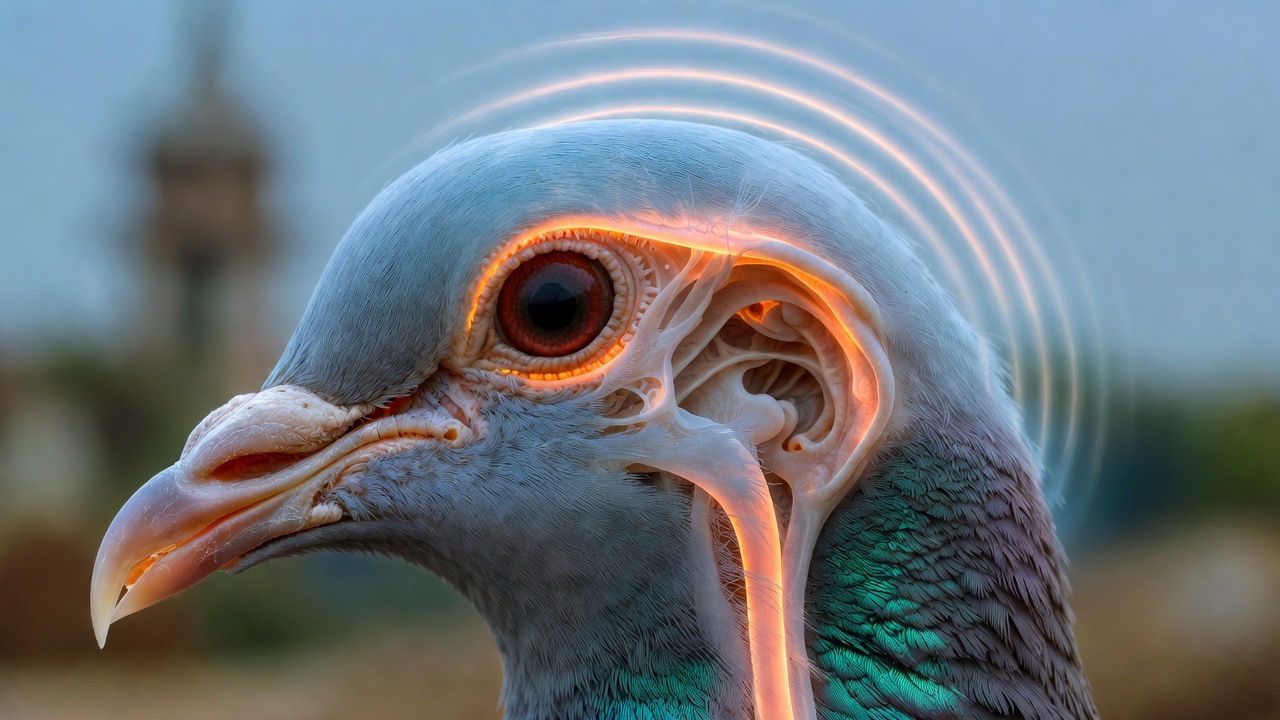
For centuries, the mystery of how birds navigate thousands of miles to return to the exact same backyard or cliffside nest has captivated scientists and poets alike. We now know that a bird’s brain is not just a biological computer, but the command center for a suite of sophisticated navigation tools. From harnessing the bizarre laws of quantum mechanics to reading the Earth’s magnetic field and memorising entire landscapes, birds are equipped with a guidance system that rivals—and in some ways surpasses—human technology.
For birds like the Arctic tern, a migration route can cover enough distance in a lifetime to travel to the moon and back . But this incredible feat isn’t magic; it’s biology, physics, and memory working in perfect harmony. To find their way, birds effectively have a “compass” to give them direction and a “map” to tell them where they are relative to home . Here is how they do it.
The Quantum Compass: Entanglement in the Eye
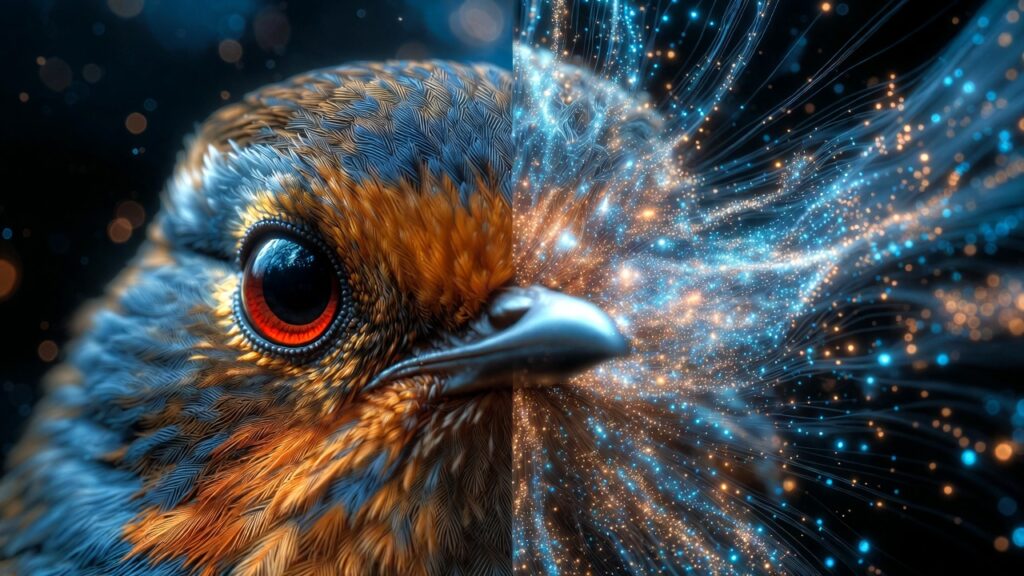
Perhaps the most astonishing discovery in modern biology is that some birds, particularly night-migratory songbirds like the European robin, can literally see the Earth’s magnetic field using quantum mechanics .
Deep within the retina lies a protein called cryptochrome. When light hits this protein, it triggers a reaction that knocks an electron loose, creating a pair of molecules with unpaired electrons known as a radical pair . Critically, these two electrons are quantum-entangled—their states are linked regardless of the distance between them .
The Earth’s weak magnetic field (about 50 microtesla) subtly influences the spin states of these entangled electrons . This, in turn, alters the outcome of a chemical reaction, creating a visual signal that varies depending on the bird’s orientation relative to the magnetic field . Essentially, the bird sees patterns or shadows overlaying its vision that indicate direction. Researchers have confirmed that this process is so sensitive that birds can detect magnetic field variations as small as 1.5 microtesla .
Remarkably, this “quantum compass” is light-dependent. The radical pair mechanism requires specific wavelengths (blue light) to function, which explains why birds in total darkness struggle to orient magnetically . Experiments have shown that radio frequencies can disrupt this compass, with studies on Eurasian blackcaps confirming that specific frequencies interfere with their ability to navigate .

A Backup Compass: The Inner Ear
While the eye-based quantum compass is widely accepted for migratory songbirds, new research published in Science (2025) suggests that other birds, like homing pigeons, have a secondary magnetic sense located in the inner ear .
This theory dates back to 1882, when a zoologist suggested that magnetic fields might induce tiny electric currents in the fluid of the ear canals. A team from Ludwig Maximilian University of Munich recently confirmed this hypothesis. They found that specific hair cells in the semicircular canals respond to magnetic fields .
When the researchers exposed pigeons to magnetic field changes, the vestibular nuclei (the brain region that receives information from the inner ear) lit up. Importantly, this happened even in the dark, proving that this system operates independently of the light-dependent system in the eye . This dual-receptor system might allow birds to cross-check their directional information, making their navigation incredibly robust.
Celestial Guides: The Sun and Star Compasses
Of course, birds also use the most obvious cues in the sky: the sun and the stars. This is where the bird’s brain acts like an ancient mariner, using celestial bodies to stay on course.
- The Sun Compass: Birds that migrate during the day use the sun’s position to orient themselves. However, because the sun moves across the sky, birds must compensate for the time of day. They use their internal circadian rhythm to adjust for the sun’s movement, effectively allowing them to maintain a constant direction even as the sun arcs overhead . If a bird’s internal clock is disrupted (through clock-shift experiments), it makes predictable navigational errors .
- The Star Compass: Night-migrating birds, such as warblers and thrushes, cannot rely on the sun. Instead, they learn the night sky. Research shows that they navigate not by following a single star, but by learning the rotation of the constellations around the celestial pole (Polaris, the North Star) . This allows them to find true north regardless of the time of night or season.
The Navigational Map: Smell and Memory
A compass tells a bird which way is north, but it doesn’t tell it where “home” is. To solve that problem, birds need a “map.” Scientists have identified two primary sources for this map, which work in tandem depending on how familiar the terrain is.
1. The Olfactory Map (Smell)
For homing pigeons released in unfamiliar locations, the ability to smell is critical. The “olfactory navigation” theory suggests that pigeons learn the odours of their home region and associate them with the direction of the wind that carried them . When displaced to a new area, they sample the local smell. By recognising the unique “odour profile” of that location, they can recall which wind direction usually carries that scent to the loft, thus giving them a bearing .
Research published in ScienceDirect confirms that the piriform cortex, the brain’s odour-processing centre, is essential for this. If pigeons are made anosmic (unable to smell), they fail to orient homeward from unfamiliar sites .
2. The Visual Map (Landmarks)
Once a bird gets closer to home or is flying over familiar territory, it switches from smell to sight. This is where the hippocampus, the memory centre of the brain, takes over .
Birds create what is essentially a “cognitive map” of landmarks. They memorise rivers, roads, coastlines, and woodlots. GPS tracking of pigeons has revealed that they often use linear landmarks—like highways or rivers—as “leading lines” to guide their flight path . If the hippocampus is damaged, birds can still fly in the right direction using their compass, but they fail to recognise the final familiar landmarks near the loft, resulting in tortuous, confused flight paths when trying to actually locate the home site .
Putting It All Together: The Avian GPS
These systems don’t work in isolation. A bird’s brain integrates these signals in a hierarchical manner. For instance, when using the sun compass, a bird must compare that information to the magnetic field to calibrate it . Furthermore, if the magnetic field is disrupted by solar storms (space weather), studies using weather radar data show that migration intensity drops by up to 17%, and birds become more likely to drift with the wind, suggesting they fall back on less precise methods of orientation when their primary compass is jammed .
Recent research on reed warblers suggests that the distinction between the “map” and “compass” senses may be blurrier than we thought. When researchers altered specific magnetic parameters (inclination and intensity) to simulate a virtual displacement, the birds acted as if they had been moved, indicating they can derive positional information from the same magnetic field they use for direction .
Conclusion
The compass in a bird’s brain is not a single instrument, but a masterfully integrated toolkit. It combines the spooky world of quantum entanglement with the earthy reality of a smelly wind and the mental image of a familiar river bend. As science unravels these mysteries, we gain not only a deeper appreciation for the feathered travellers sharing our planet, but also inspiration for new technologies, from quantum sensors to GPS-free navigation systems .
References
- European Commission, CORDIS. (2025). Radical pair-based magnetic sensing in migratory birds – QuantumBirds.
- eLife. (n.d.). Research organism: Hair cells and cuticulosomes in the avian inner ear. eLife.
- Oxford University Press. (2024). Animation 29.2: Time-Compensated Solar Compass. Learning Link.
- Gagliardo, A., Pecchia, T., Savini, M., Odetti, F., Ioalè, P., & Vallortigara, G. (2007). Olfactory lateralization in homing pigeons: initial orientation of birds receiving a unilateral olfactory input. European Journal of Neuroscience, 25(5), 1511-1516.
- Gagliardo, A., et al. (2002). Bilateral participation of the hippocampus in familiar landmark navigation by homing pigeons. Behavioural Brain Research, 136(1), 201-209.
- Gulson-Castillo, E. R., et al. (2023). Space weather disrupts nocturnal bird migration. Proceedings of the National Academy of Sciences, 120(42), e2306317120.
- Nature Communications. (2024). Magnetosensitivity of tightly bound radical pairs in cryptochrome is enabled by the quantum Zeno effect. Nature Communications, 15, 10823.
- Science Magazine. (2012). Magnetoreception: The lagena in the inner ear. Science, 336, 1054.
- Macmillan Learning. (n.d.). Time-Compensated Solar Compass. Life, 11e.
- Bingman, V. P., et al. (1994). Connections of the piriform cortex in homing pigeons (Columba livia) studied with Fast Blue and WGA-HRP. Brain, Behavior and Evolution, 43(4-5), 206-218.








Leave a Reply