

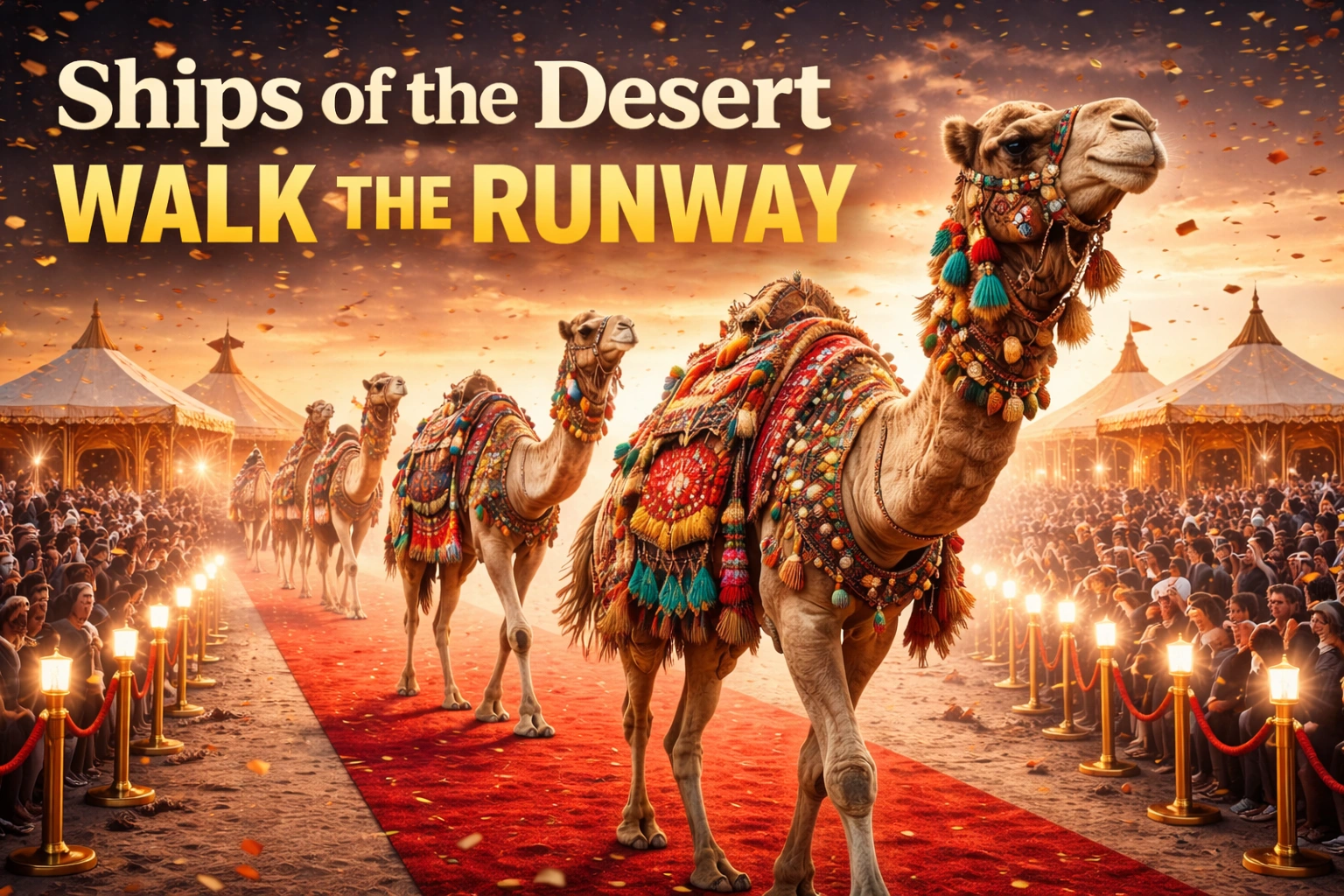
At first glance, the idea of a beauty pageant for camels might sound like a quirky novelty, perhaps a humorous distraction from the serious business of the Middle East. But step into the desert arenas of Saudi Arabia, Qatar, or the UAE during festival season, and you will find a world that is anything but trivial. Welcome to the strange, high-stakes universe of camel beauty contests—a multi-million dollar industry where ancient Bedouin traditions meet modern controversies involving Botox, silicone, and high-tech cheating scandals.
Far from being a silly event, these contests are a fascinating lens through which to view the cultural soul of the Arabian Peninsula, its massive oil wealth, and its struggle to preserve heritage in a rapidly modernizing world.
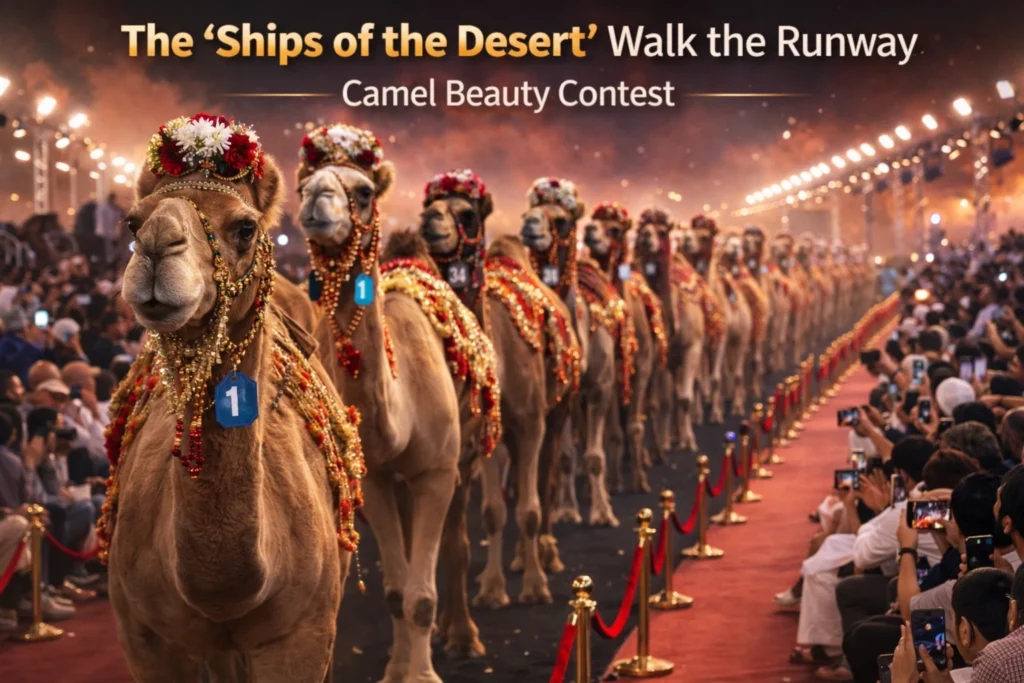
The ‘Ships of the Desert’ Walk the Runway
The most prestigious of these events is Saudi Arabia’s King Abdulaziz Camel Festival (also known as Mazayen al-Ibl), held annually in the deserts near Riyadh. What began in 1999 as a small gathering of Bedouin tribes has exploded into a massive 40-day extravaganza. In recent editions, the festival has offered prize money totaling up to $66 million, attracting breeders from across the Gulf Cooperation Council (GCC) and beyond .
This isn’t just a contest; it is a cultural renaissance. The festivals celebrate the role of camels in Bedouin history, aiming to preserve purebred strains that have been prized for centuries .
The Ideal Beauty Standard: Luscious Lips and a Proud Hump
So, what makes a camel a supermodel? Forget the runway strut; the judges’ criteria are surprisingly specific and, in a way, relatable to human pageants.
According to the rules, a winning camel must have a large, long head with drooping lips—so full that they cover the teeth. They are judged on the size of their eyes, the length of their eyelashes, and the length of their necks. The hump must be high, firm, and perfectly positioned slightly to the back .
Camels are divided into categories based on color and breed: the majestic black Majaheem, the white Maghateer, and the dark brown Shi”l all compete for the coveted title of “Bayraq.” Winning this title isn’t just about glory; it instantly transforms a camel into a status symbol worth millions .
A Scandal in the Desert: When Fillers Go Wrong
However, where there is money and prestige, there is also cheating. In recent years, the world of camel pageantry has been rocked by scandals that sound like they belong in a Beverly Hills plastic surgery clinic.
In February 2026, the Camel Beauty Show Festival in Al Musanaa, Oman, made international headlines for the wrong reasons. Veterinary inspectors disqualified 20 camels after discovering they had received a cocktail of cosmetic enhancements. The “crimes” included:
- Botox injections to soften facial features.
- Hyaluronic acid fillers in the lips.
- Silicone wax used to inflate humps to make them appear taller and more shapely .
Organizers were furious. “We are keen to halt all acts of tampering and deception in the beautification of camels,” they stated, vowing strict penalties . This wasn’t an isolated incident. In 2021, Saudi Arabia disqualified 40 camels from the King Abdulaziz festival for similar offenses, including the use of Botox and hormone injections to stretch noses and lips .
This has sparked a heated debate. While owners invest in these procedures to win a piece of the massive prize pot, animal rights activists decry the practice as cruel. Jason Baker of PETA Asia commented, “Subjecting any animal to a cosmetic procedure… is hideously cruel” . Veterinarians warn that such procedures can lead to painful infections, tissue damage, and life-threatening abscesses for the animals .
Tradition Meets Vision 2030
Beyond the glitz and the scandals, these festivals are also a mirror reflecting social change. In 2022, the King Abdulaziz Festival made history by hosting its first-ever women’s camel beauty pageant. Previously a men-only affair, the inclusion of women marked a significant shift in the conservative kingdom.
Around 40 women participated, parading their camels and competing for a share of one million riyals (approximately $260,000). Among them was seven-year-old Malath bint Enad, the youngest contestant, who won third prize .
Organizers framed this as a return to roots. “Women have always been an integral part of Bedouin society. They owned and looked after camels,” said festival manager Mohammed al-Harbi. Participant Munira al-Mishkhas added, “Camels have been a part of us for a long time, but staging a contest for us (women) is a big step forward” . This move aligns perfectly with Saudi Arabia’s Vision 2030 agenda, which seeks to open the country, boost tourism, and empower women while celebrating cultural heritage .
The Future of Beauty
To combat the cheaters, organizers are getting smarter. Festivals now employ specialized veterinarians and advanced screening techniques, including X-rays and ultrasound scanners, to detect hidden fillers and artificial enhancements . Meanwhile, in Qatar, the focus is shifting to the humans behind the评判. The Qatar Camel Festival recently introduced the “Raa’i Al Nazar” accolade—a competition to train and select the next generation of highly skilled judges, proving that this heritage industry is investing heavily in its future .
Camel beauty contests occupy a strange and wonderful space in the modern Middle East. They are a living link to a nomadic past, a display of petrodollar wealth, and a surprisingly current arena for debates on ethics, animal welfare, and social progress. Whether you view it as a beautiful tradition or a bizarre spectacle, one thing is certain: in the desert, beauty is serious business.
The Scale of the Scandals: How Many Camels Were Caught?
The use of Botox and fillers in camel beauty contests is not just a one-off oddity; it is a recurring issue that has led to mass disqualifications across the Gulf region. Here are the most significant cases:
As the table shows, the problem escalated significantly by 2021, with over 40 camels disqualified in a single crackdown at Saudi Arabia’s prestigious King Abdulaziz festival. This event highlighted the extreme measures some owners will take to win a share of prize money that can reach up to $66 million .
The 2026 scandal in Oman confirms that despite increased vigilance, the practice of cosmetic tampering continues . Organizers are now employing advanced technology, including X-rays and 3D ultrasound machines, to detect these illegal enhancements and protect the integrity of the competitions .
The Dark Side of Desert Beauty: A Closer Look at Camel Cosmetic Scandals
The recent disqualification of 20 camels from the 2026 Camel Beauty Show Festival in Al Musanaa, Oman has once again thrust this unusual corner of Gulf culture into the international spotlight. But to truly understand why owners would risk injecting their prized animals with Botox and fillers, we need to explore the intricate world of camel beauty pageants in greater depth.
The 2026 Oman Scandal: What Actually Happened?
In February 2026, veterinary inspectors at the Omani festival made a startling discovery. During routine examinations, they found evidence that approximately 20 camels had undergone various cosmetic procedures to enhance their appearance . The festival, which drew participants from every governorate in Oman according to the state-backed Oman News Agency, prides itself on celebrating authentic Bedouin heritage .
The violations were uncovered through specialized veterinary screening, which included detailed examinations of the camels’ heads, necks, and torsos . Judges had reportedly become suspicious when some animals displayed unusually plump lips, perfectly shaped humps, and exaggerated facial features that seemed too perfect to be natural .
Festival organizers from the Camel Club and the Oman Camel Racing Federation responded decisively, issuing a strongly worded statement declaring they were “keen to halt all acts of tampering and deception in the beautification of camels” and promising “strict penalties on manipulators” .
The Complete “Beauty Menu”: What Enhancements Were Used?
The range of cosmetic procedures discovered reads like a catalog from a high-end human plastic surgery clinic. According to multiple reports, the disqualified camels had received a combination of the following enhancements :
| Enhancement Type | Purpose | Substances Used |
|---|---|---|
| Lip Enhancement | Create fuller, more desirable “pouty” lips | Hyaluronic acid injections (similar to human lip fillers) |
| Facial Softening | Relax facial muscles for a smoother, more elegant expression | Botox injections |
| Nose Reshaping | Refine the nasal profile to meet beauty standards | Dermal fillers and silicone |
| Hump Augmentation | Increase hump size and improve shape | Silicone wax injections |
| Muscle Definition | Create a more muscular, athletic appearance | Hormone treatments |
This is essentially a complete ” cosmetic makeover” for camels, with owners willing to invest significant money in these procedures for a chance at glory .
Why Such Desperate Measures? The Millions at Stake
To understand why breeders resort to these extreme measures, one must appreciate the staggering economics of camel beauty contests. The prizes are enormous—the King Abdulaziz Camel Festival in Saudi Arabia, the world’s largest such event, offers prize money exceeding $60 million .
But the prize money is just the beginning. A camel that wins a major beauty title—known as “Bayraq”—instantly becomes a celebrity in the breeding world. Its value can skyrocket into the millions, and it gains access to premium breeding opportunities that can generate substantial income for its owner for years to come .
As one report noted, winning at these events “will also increase the value of the camel when it goes on sale” . For breeders, this creates an enormous financial incentive to gain any possible advantage, even if it means breaking the rules.
A History of Cheating: The Saudi Scandals
The 2026 Oman incident is far from isolated. Saudi Arabia’s King Abdulaziz Camel Festival has faced similar controversies multiple times:
- 2018: 12 camels were disqualified for receiving Botox injections—ironically, from horse breeders who were presumably skilled in equine injections . The enhancements targeted lips, noses, and jaws to create artificially enlarged heads .
- 2021: The scandal grew much larger, with over 40 camels disqualified . Inspectors found evidence of Botox, collagen fillers, and even more primitive methods like rubber bands used to stretch body parts by restricting blood flow . The Saudi Press Agency stated at the time, “The club is keen to halt all acts of tampering and deception in the beautification of camels” .
These recurring scandals reveal a cat-and-mouse game between organizers trying to preserve authenticity and breeders seeking an edge in an increasingly competitive and lucrative field.
The Technology Arms Race: How Organizers Fight Back
In response to these sophisticated cheating attempts, festival organizers have dramatically upgraded their inspection capabilities. The King Abdulaziz Camel Festival now employs what can only be described as advanced forensic technology :
- X-ray scanners to detect foreign substances beneath the skin
- 3D ultrasound machines to examine tissue composition and identify silicone or fillers
- Genetic testing to verify camel pedigrees and prevent substitution
- Specialized veterinary teams trained to spot the subtle signs of cosmetic intervention
All contestants are first led into a hall where their external appearance and movements are examined by specialists, before undergoing these advanced tests on their heads, necks, and torsos . This represents a significant investment in maintaining the integrity of the competitions.
The Animal Welfare Debate: Is This Cruelty?
The cosmetic procedures have drawn sharp criticism from animal welfare organizations and veterinary experts. The concerns are both ethical and medical :
Health risks include:
- Severe pain during and after procedures
- Infections at injection sites
- Chronic swelling and bruising
- Tissue damage and necrosis
- Formation of potentially life-threatening abscesses
- Silicone migration to other parts of the body causing complications
- Hormonal imbalances from muscle-building treatments
Jason Baker, the senior vice-president of PETA Asia, did not mince words: “Subjecting any animal to a cosmetic procedure, from ear cropping to declawing, dehorning and filler injections, is hideously cruel and shows the humans who use such tactics to be extremely ugly” .
Veterinarians warn that beyond the immediate risks, these procedures can cause long-term health problems and difficulties with basic functions like eating .
Cultural Significance: More Than Just a Beauty Contest
To understand why this matters so much, one must appreciate the deep cultural significance of camels in Gulf societies. Camels have been central to Bedouin life for millennia—as transport, as food, as fabric, and as a measure of wealth and status .
These festivals are not merely frivolous pageants; they are celebrations of heritage that include races, cultural performances, auctions, and breeding showcases . They preserve purebred strains that have been prized for centuries and maintain connections to a nomadic past that modernization threatens to erase.
The festivals also reflect broader social changes. The recent inclusion of women’s competitions at the King Abdulaziz festival aligns with Saudi Arabia’s Vision 2030 reforms, marking a significant shift in a previously male-dominated space .
Saudi Arabia’s Innovative Solution: Camel Passports
In a fascinating development, Saudi Arabia has launched a project to issue special passports for camels as part of efforts to regulate and develop the Kingdom’s camel sector . These passports serve multiple purposes:
- Tracking ownership and pedigree
- Recording medical history and treatments
- Preventing substitution of animals
- Ensuring compliance with competition rules
- Facilitating the growing camel trade
This bureaucratic innovation demonstrates just how seriously the camel industry is taken in the region—treated with the same regulatory seriousness as international human travel.
The Bigger Picture: Tradition Under Pressure
The cosmetic enhancement scandals reveal a tension at the heart of modern Gulf societies: how to preserve authentic traditions while managing the distorting effects of enormous wealth.
The prize money that makes these festivals so exciting also creates perverse incentives. The desire to win, to gain status, and to secure financial returns drives some breeders to compromise the very authenticity the festivals seek to celebrate.
As one commentator wryly noted, “whether human or camel, artificial enhancements compromise the spirit of competition. The lesson for breeders? Leave the Botox and fillers off the camels—or risk being shown the desert door” .
Conclusion: The Future of Camel Beauty
The strange world of camel beauty contests continues to evolve. With prize money reaching tens of millions, the pressure to win will only increase . Organizers are responding with ever-more-sophisticated detection methods, from X-rays to 3D ultrasound . Animal welfare advocates continue to raise concerns about the ethics of subjecting animals to cosmetic procedures .
What remains clear is that these contests occupy a unique space in the modern Middle East—simultaneously ancient and hyper-modern, deeply traditional yet shaped by contemporary pressures. The battle between authenticity and artificial enhancement is likely to continue for years to come, playing out in the deserts of Oman, Saudi Arabia, and beyond, where beautiful camels with their proud humps and luscious lips compete for glory, prestige, and life-changing prize money.
As long as millions are at stake, there will always be breeders willing to give their camels a little “help”—and organizers determined to catch them.

Leave a Reply