

The animal kingdom is full of harsh realities and incredible adaptations, but few are as startling and awe-inspiring as the birth of a giraffe. A giraffe calf’s entrance into the world is a dramatic, six-foot drop to the ground. Yet, within an hour, this lanky newborn will perform another miracle: it will stand, wobble, and begin to walk. This isn’t just a fascinating party trick; it is a brutal and necessary race against time for survival.
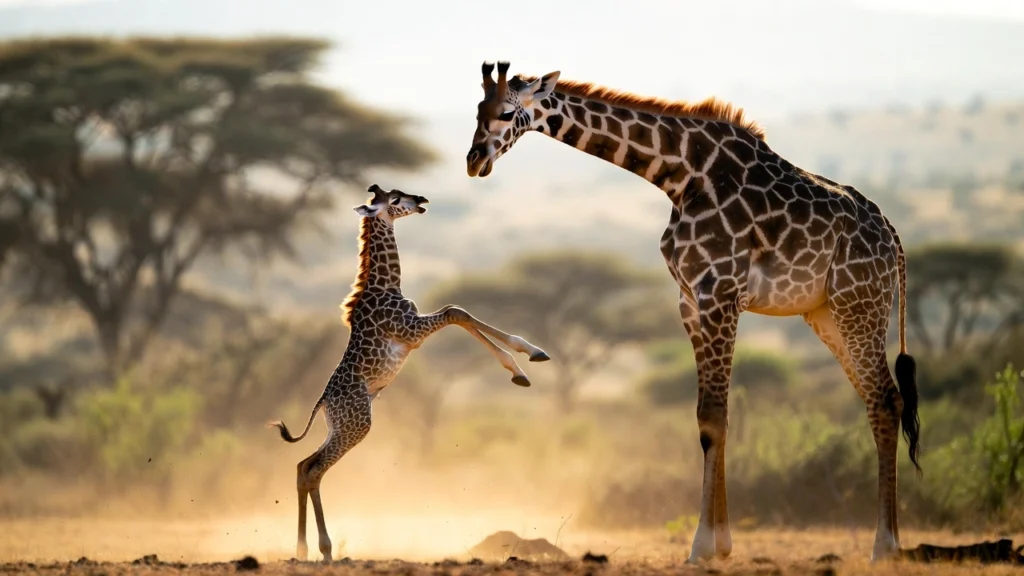
A 15-Month Wait and a “Superman” Landing
The journey begins after a gestation period of approximately 15 months (about 453–464 days) . When a mother giraffe, or cow, is ready to give birth, she remains standing, a behavior that is critical for both her safety and the calf’s. Giving birth standing up allows her to stay vigilant and ready to flee from predators like lions or hyenas that might see her as an easy target during this vulnerable time .
As the calf emerges, it does so in what is often described as a “superman” position—front legs stretched out in front of its body and head laid back, a posture that helps the long limbs pass through the birth canal . Then comes the moment that seems shocking to human observers: the newborn plummets over five to six feet to the ground .
This seemingly harsh landing is actually a vital biological mechanism. The impact of the fall serves two crucial purposes: it helps rupture the umbilical cord and, most importantly, it stimulates the calf to take its first breath .
Why They Must Walk or Die
For a human baby, taking a first step is a milestone celebrated over a year later. For a giraffe calf, it is an urgent necessity. The newborn must stand and walk within an hour of its fall . In many cases, calves are on their feet in just 30 minutes .
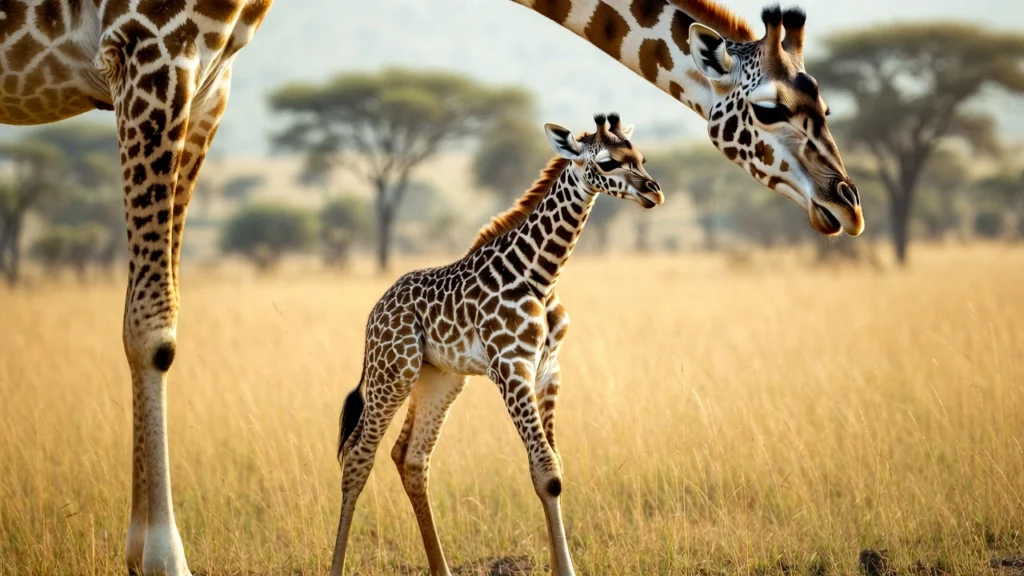
So, how do they accomplish this so quickly? Giraffes are what scientists call “precocial” animals . Unlike “altricial” species like humans, who are born helpless and require extensive care, precocial animals are born relatively mature and mobile. Neuroscientist Dr. Jean-Marie Graïc explains that a newborn giraffe’s nervous system is essentially ready at birth, like that of a one-year-old human child prepared to walk . This rapid development allows the calf to focus its energy on muscle control and coordination from the moment it enters the world.
The reason for this haste is simple: predators. In the African savanna, a newborn calf is a prime target for lions, hyenas, leopards, and wild dogs. In areas with high predator densities, more than 50% of giraffe calves do not survive their first year . A calf that cannot stand cannot follow its mother, and a calf that is left behind is a guaranteed meal. The ability to get up and move with the herd is the single most important factor for survival. The mother assists by nudging and licking the calf, providing encouragement and helping to clear its membranes .
A Six-Foot-Tall Newborn
The size of these calves adds another layer of wonder to their quick mobility. At birth, a baby giraffe already stands an astonishing six feet tall—roughly the height of a full-grown adult human . They weigh between 100 and 150 pounds at birth, with some sources citing weights up to 220 pounds .
Their height serves an immediate purpose. Once the calf has mastered the art of standing, it can finally reach up to nurse from its mother. The first milk, known as colostrum, is rich in essential nutrients and antibodies that give the calf a vital health boost . The calf will continue to rely on its mother’s milk for the next 9 to 12 months, although it will begin to sample solid foods, like leaves, at around four months of age .
Life as a Young Giraffe
The first few weeks of a calf’s life are precarious. To keep her offspring safe while she goes off to feed, the mother giraffe will often hide her calf in tall grass or bushes . The calf’s natural camouflage—its spotted coat—helps it blend into the dappled sunlight of the savanna, keeping it hidden from predators .
After a few weeks, the calf is introduced to the rest of the herd, often joining a “nursery group” or creche. In these groups, one mother will stand guard and watch over the calves while the others have a chance to feed, showcasing a cooperative approach to childcare .
The journey from a six-foot fall to a steady walk in under an hour is one of nature’s most compelling stories. It is a testament to the power of evolution, where every aspect of an animal’s life—from its gestation to the birth itself—is finely tuned for survival. The baby giraffe’s first clumsy steps are not just adorable; they are the most critical steps it will ever take.









Leave a Reply